I Love You in Morse Code: Complete Translation Guide
Full breakdown of I LOVE YOU in Morse code with each letter explained, creative uses including bracelets and tattoos, the morse code jewelry trend, and romantic gift ideas.
Written and reviewed by
Morse Code Translator TeamOur editorial team researches, writes, and reviews content to provide clear and accurate information about Morse code, communication standards, learning methods, and related topics.
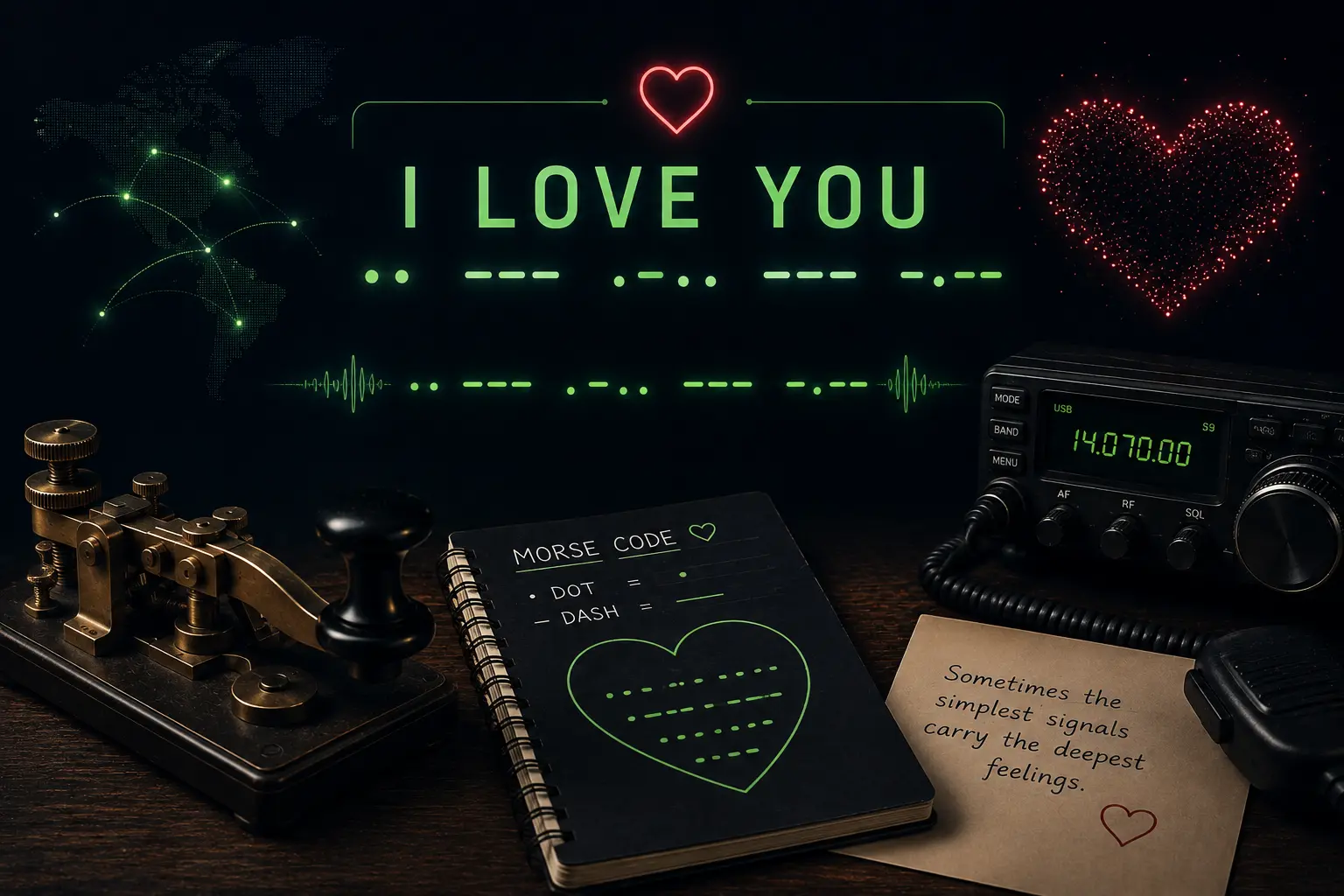
Morse code has become an unexpected and beautiful medium for expressing love and affection. The simple elegance of dots and dashes makes it a perfect cipher for secret messages, personalized jewelry, tattoos, and romantic gestures. You can create and test your own messages with our Morse Code Translator. In this guide, we provide the complete Morse code translation of “I LOVE YOU,” explain each letter's code, and explore the many creative ways people are using Morse code to express their feelings.
"I LOVE YOU" in Morse Code: Complete Translation
The full phrase “I LOVE YOU” translates to Morse code as follows:
I · · L · — · · O — — — V · · · — E · Y — · — — O — — — U · · —
Written as a continuous sequence:
·· ·—·· ——— ···— · —·——— ——— ··—
Letter-by-Letter Breakdown
Let us examine each letter and its Morse code pattern:
I — · · (dit-dit)
The letter I is represented by two dots. For a broader look at how I and every other letter are encoded, see the Morse Code Alphabet. In the context of “I LOVE YOU,” it serves as the personal pronoun — the speaker declaring their feelings. Two short dots, simple and direct, much like the feeling it represents.
L — · — · · (dit-dah-dit-dit)
L is one of the more complex letters in the alphabet, using four elements. Its pattern of dot-dash-dot-dot has a distinctive rhythm that stands out clearly in a transmission.
O — — — (dah-dah-dah)
Three dashes create the letter O. This is one of the most easily recognized characters in Morse code due to its uniform, rhythmic pattern. O appears twice in “I LOVE YOU,” providing a repeated, comforting rhythm.
V — · · · — (dit-dit-dit-dah)
The letter V is famous as the opening of Beethoven's Fifth Symphony (da-da-da-DUM!), and its Morse code pattern matches this iconic rhythm perfectly. In “I LOVE YOU,” V represents the most powerful word in any language.
E — · (dit)
The simplest character in the entire Morse code alphabet — a single dot. E is the most common letter in English, and its brevity reflects its importance. In the word “LOVE,” the E provides a brief, quiet punctuation before the declaration moves to “YOU.”
Y — — · — — (dah-dit-dah-dah)
Y has a dramatic, almost musical pattern with its alternating dashes and central dot. It adds a distinctive cadence to the beginning of “YOU,” making it stand out.
U — · · — (dit-dit-dah)
U closes the phrase with a light, ascending pattern. Two dots followed by a dash creates a sense of resolution and completeness, a fitting end to the declaration.
Creative Uses for "I Love You" in Morse Code
Morse Code Jewelry
The morse code jewelry trend has exploded in popularity over recent years. These pieces encode messages in the form of beads or metal elements arranged in dot and dash patterns along a chain or wire. The result is a piece of jewelry that appears to be a simple decorative design but secretly carries a personal, meaningful message.
Morse code bracelets are the most popular form. They typically use a thin chain or cord with small beads or metal bars arranged to represent the dots and dashes. You can create them yourself using:
- Seed beads in two different colors (one for dots, one for dashes)
- Small metal tubes and round beads for a minimalist look
- Pearl or glass beads for an elegant appearance
- Wire-wrapped designs for a handcrafted artisanal feel
Necklaces follow the same principle but have more space to work with, allowing for longer messages or more elaborate patterns. Some designs use a vertical arrangement, while others wrap the code around the pendant.
Rings can encode short messages like “LOVE” or initials in a compact design. The pattern might be engraved on the outside or inside of the band.
Morse Code Tattoos
Morse code tattoos offer a way to permanently express meaningful messages that only you (and those you choose to tell) can read. Popular designs include:
- Dot and dash patterns along a forearm or wrist, arranged in a horizontal line that reads like a sentence
- Vertical arrangements of dots and dashes along the spine, finger, or behind the ear
- Incorporating dots and dashes into existing tattoo designs, such as using dots as stars and dashes as lines within a larger image
- Minimalist single-word tattoos, encoding words like “LOVE,” “HOPE,” or “BELIEVE”
The appeal of Morse code tattoos lies in their subtlety. To the casual observer, they appear as abstract dot-and-line patterns. Only those who know Morse code — or who you choose to tell — can decode the hidden message.
Love Notes and Letters
Writing a love note or letter with Morse code adds an element of mystery and thoughtfulness. Ideas include:
- Writing the full message in Morse code and providing the recipient with a decoder chart
- Mixing plain text and Morse code — write most of the message normally but encode the most important words (like “I LOVE YOU”) in dots and dashes
- Incorporating Morse code into greeting cards as a decorative element with hidden meaning
- Creating a scavenger hunt where each clue is encoded in Morse code, leading to a final romantic surprise
Digital Messages
In the digital age, Morse code can add a unique twist to electronic communication:
- Use Morse code in text messages — send your partner a series of dots and dashes and see if they can decode it
- Social media bios — some people include Morse code messages in their profile descriptions
- Custom phone wallpapers with Morse code declarations
- Email signatures with a subtle Morse code message at the bottom
The Morse Code Gift Trend
Morse code has become a significant trend in personalized gifting. The appeal lies in the combination of personalization (you choose the message), secrecy (only the recipient may know the meaning), and aesthetic simplicity (the dot-and-dash pattern is visually clean and modern).
Popular Morse code gift ideas include:
- Custom bracelets and necklaces from Etsy or artisan jewelers
- Engraved keychains with a Morse code message
- Printed posters or wall art featuring a phrase in Morse code
- Custom mugs or coasters with a secret message
- Embroidered Morse code on clothing or accessories
When giving a Morse code gift, consider including a small card explaining the code, or better yet, teaching the recipient how to read it. The shared secret becomes part of the gift itself.
How to Share "I Love You" in Morse Code
If you want to share “I LOVE YOU” in Morse code with someone special, here are some memorable approaches:
- 1Learn it yourself and tap it out. Gently tap the rhythm on their hand — it is an intimate, tactile way to communicate.
- 2Write it in a card. Write the dots and dashes beautifully, perhaps in gold or silver ink on dark paper.
- 3Create a piece of jewelry. Whether handmade or custom-ordered, a morse code bracelet or necklace is a gift they will treasure.
- 4Flash it with a flashlight. In a dark room or under the stars, flash the message using a flashlight — it is both romantic and dramatic.
- 5Record it as audio. Use a Morse code audio tool to create an audio file of the message and send it as a surprise voice message.
The beauty of expressing love in Morse code is that it requires thought, effort, and intention. In an age of instant communication, taking the time to encode and share a message in Morse code is itself an act of love — a signal that the person and the message are worth extra effort.
For more common phrases, see our guide to Hello in Morse Code and 15 Common Phrases.
Keep Learning
Related Articles

Morse Code Timing Rules: Dots, Dashes & WPM Explained
Complete guide to Morse code timing rules including the PARIS standard, dot/dash ratios, timing units, WPM calculation, Farnsworth method, and professional speed standards.
Morse Code Quiz: 50 Questions to Test Your Knowledge
50 quiz questions organized by difficulty from beginner to expert, covering letters, numbers, phrases, history, timing, and Morse code trivia with answers provided.
SOS Signal in Morse Code: Complete Emergency Guide
Complete guide to the SOS distress signal including its history, what SOS means, the Titanic story, how to signal SOS with light and sound, and modern emergency alternatives.