How to Learn Morse Code
A comprehensive, step-by-step guide for complete beginners. Learn Morse code from zero to proficiency using proven methods, mnemonic tricks, and daily practice routines.
New to the subject? Start with our guide to what Morse code is to understand the system before beginning structured practice.
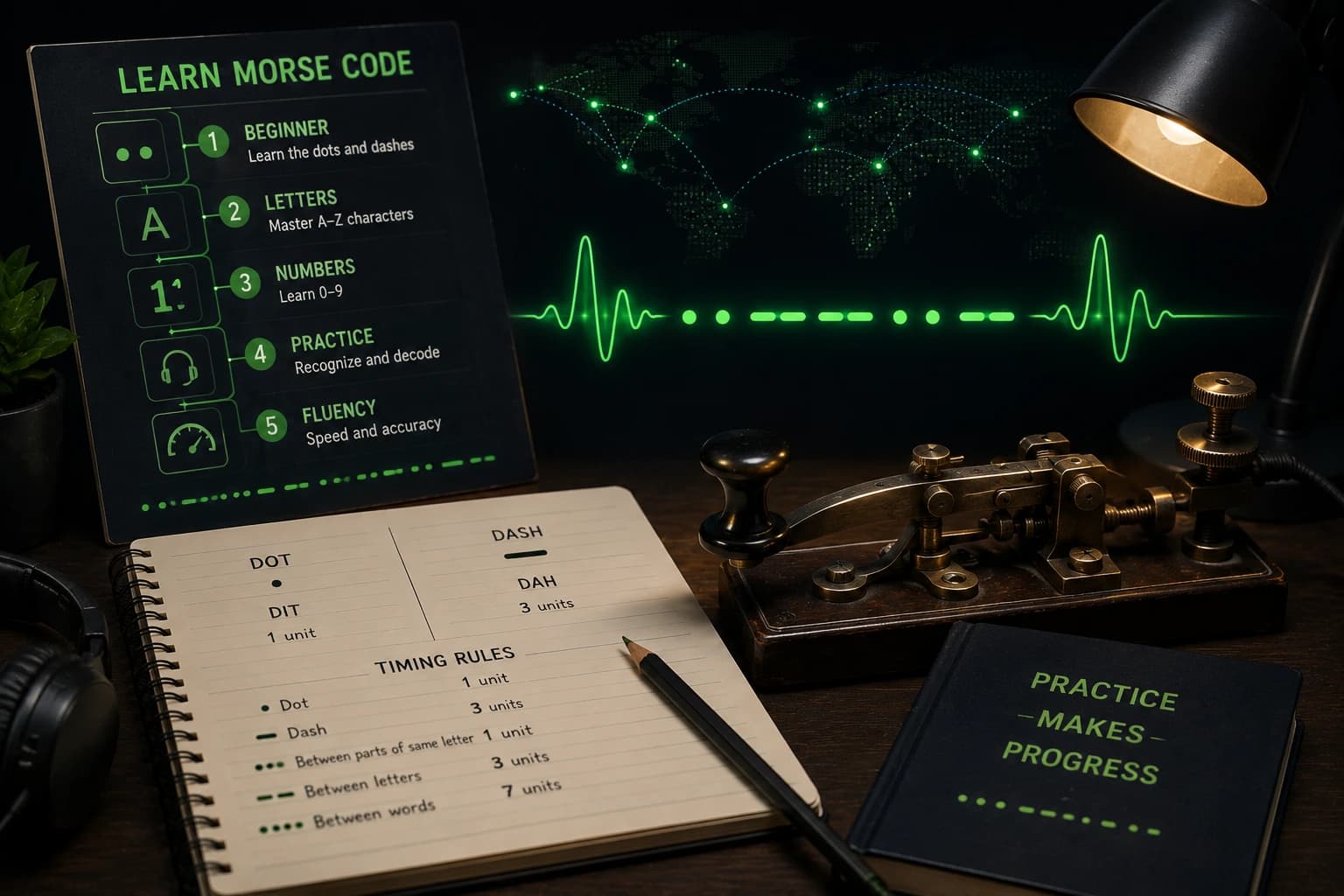
Learn the Complete Morse Code Alphabet
Your first step is to become familiar with the International Morse Code alphabet. Every letter from A to Z is represented by a unique combination of dots (short signals) and dashes (long signals). Start by reviewing the complete Morse Code Alphabet chart. Don't try to memorize everything at once — just get a feel for the overall system. Notice that simpler letters like E (single dot) and T (single dash) are the shortest, while less common letters like Q and J have four signals. This is because Morse and Vail designed the code so that the most frequently used letters are the quickest to transmit, saving time and reducing errors over telegraph lines.
Print out or bookmark the alphabet chart and keep it handy. You'll refer to it constantly in the beginning. Morse code uses two basic signal elements — short and long — combined with timing and spacing. That makes the system compact, but successful learning depends on recognizing complete character patterns rather than treating every message as a sequence of isolated dots and dashes. There are only 26 letters, 10 numbers, and a handful of punctuation marks to learn, and many of them follow recognizable patterns. Once you understand the letters, you can also study our Morse Code Numbers guide to learn the digits 0–9.
Master the Most Common Letters First
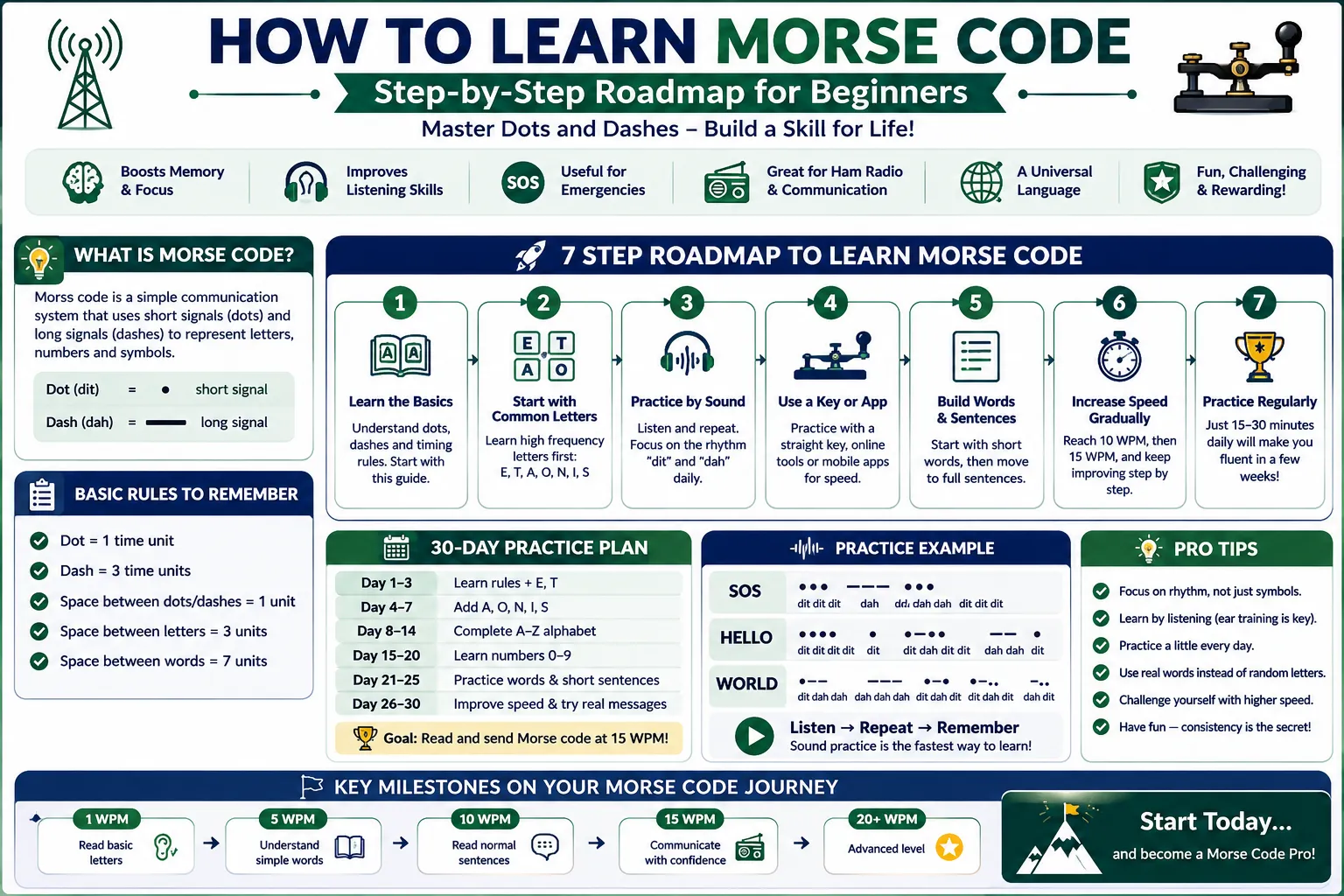
Not all characters need to be learned at once. A practical beginner strategy is to start with a small group of simple, familiar characters and add more as recognition becomes reliable. E, T, A, I, N, O, S, and H are often used as an introductory set, but exact character frequencies vary by language and text. The real goal is fast, confident recognition rather than memorizing frequency statistics.
Here are the codes for these essential letters: E is a single dot (.), T is a single dash (-), A is dot-dash (.-), I is two dots (..), N is dash-dot (-.), O is three dashes (---), S is three dots (...), and H is four dots (....). Notice the patterns: E and T are the simplest (one signal each), I and S extend the dot pattern, while N and O use dashes. A bridges both worlds. Start with E and T, then add A and N, then I and O, then S and H. Practice these until you can recall them instantly without looking at the chart.
Practice with Short Words
Once you know the most common letters, start putting them together in short words. This builds your reading speed and helps you transition from recognizing individual characters to reading words as wholes. Start with the simplest words: "it" (.. -), "at" (.- -), "to" (- ---), "is" (.. ...), "in" (.. -.), "an" (.- -.), "on" (--- -.), "no" (-. ---), "so" (... ---), "as" (.- ...).
Then move on to slightly longer words: "the" (- .... .), "and" (.- -. -..), "that" (- .... .- -), "this" (- .... .. ...), "with" (.-- .. - ....). You'll notice that even with just 8-10 letters, you can decode many common words. Use our Morse Code Translator to practice — type a word, see the Morse code, then try to write the code from memory and check your work. If you already have Morse code and want to convert it back into readable text, use our Morse Code Translator.
Use Mnemonic Devices
Mnemonic devices are memory aids that help you associate each letter's code with something memorable. The more vivid and personal the association, the better it works. Here are some tried-and-true mnemonics for Morse code:
For E (.), think "Elmer Fudd's nose" — just one little dot. For T (-), think "Tail" — one long dash. For A (.-), think "A-bove" — a small peak going up. For N (-.), think "N-o" — start with a negative (dash) then a small positive (dot). For M (--), think "M-mountain" — two big peaks side by side. For O (---), think "Oh my God!" — three long exclamations. For S (...), think "S-snake" — three quick hisses. For H (....), think "Hurry up!" — four rapid taps.
Create your own mnemonics for the remaining letters. The best ones connect the sound or shape of the letter with the rhythm of the dots and dashes. Silly, absurd, or emotionally charged associations tend to be the most memorable.
Practice Listening to Morse Code Audio
Reading Morse code from a chart is one skill; recognizing it by ear is quite another. To become truly proficient, you need to train your ears to identify characters by sound. Start by listening to each letter individually at a slow speed (5-10 WPM) using our Morse Code Sounds resources and audio playback. Pay attention to the rhythm — the relationship between the dot and dash lengths.
Once you can identify individual letters by ear, start listening to short sequences of 2-3 letters, then whole words. A critical aspect of listening practice is developing your sense of timing. In Morse code, the space between elements within a letter is equal to one dot, between letters is three dots, and between words is seven dots. For a deeper explanation of spacing and signal duration, see our Morse Code Timing reference. Set aside a short, repeatable block of time for listening practice. Consistency is far more important than duration — 15 minutes every day will yield much better results than 3 hours once a week.
Koch Method vs Farnsworth Method
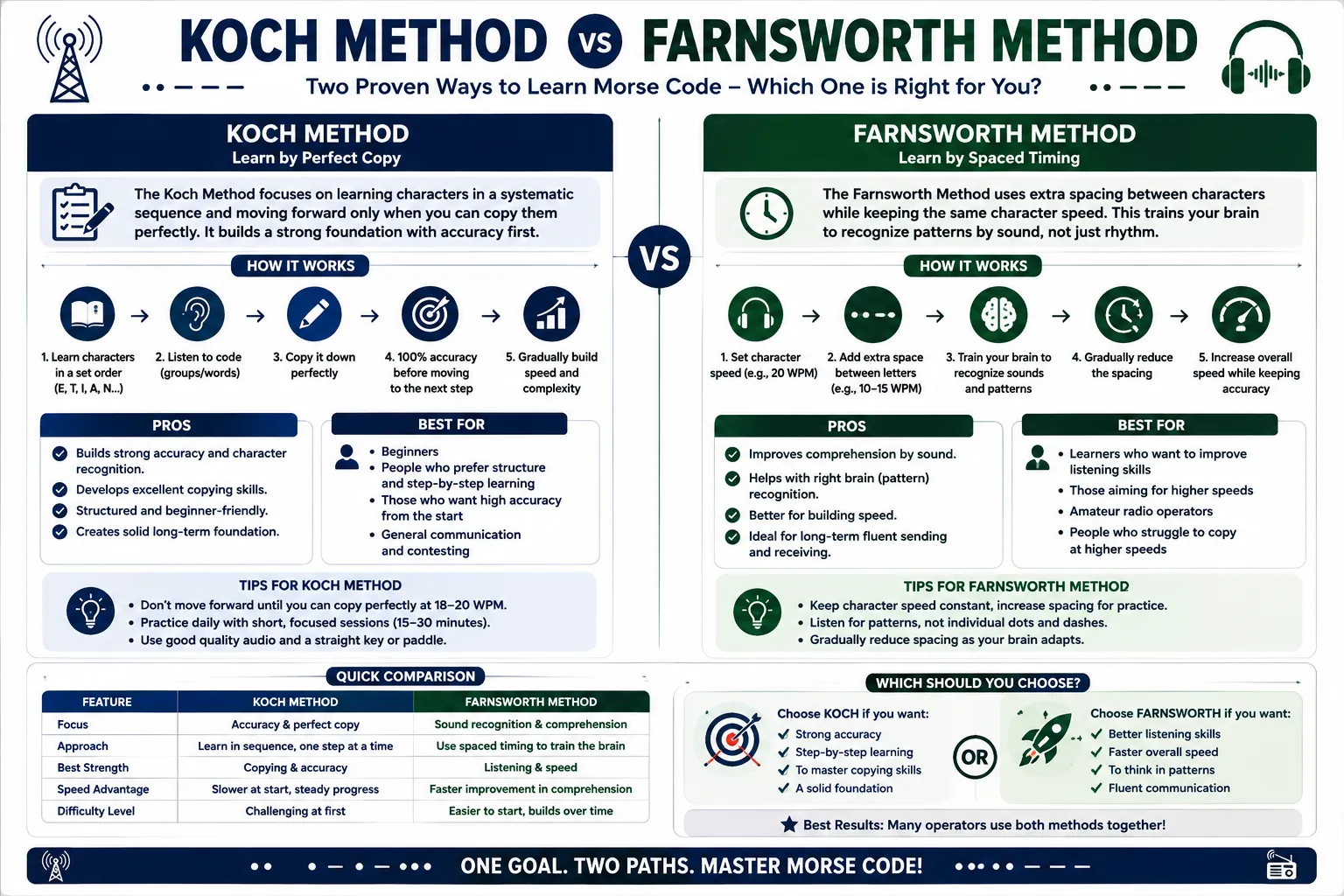
Use the Koch Method for Systematic Learning
The Koch method is a widely used structured approach to Morse code training. It introduces a small number of characters and adds new ones as recognition improves. A key idea is to expose learners to the characteristic sound of a character early, instead of teaching very slow dots and dashes that must later be relearned at higher speeds.
In practice, a Koch-style lesson begins with a small set of characters presented at a relatively high character speed. You copy what you hear, review the errors, and introduce additional characters as the current set becomes familiar. Exact starting speeds, character sets, and accuracy thresholds can be adjusted to suit the learner and the training program.
The main learning benefit is the emphasis on direct character recognition. Instead of consciously counting every dot and dash, you gradually learn the rhythm of the complete character. With enough listening and copying practice, familiar characters can become recognizable as distinct sound patterns. Use our Morse Code Quiz to practice with this method.
Test Yourself and Track Your Progress
Regular testing is essential for identifying weak spots and maintaining motivation. Use our interactive Morse Code Quiz to test yourself on individual characters, words, and even full sentences. Track your scores over time to see your improvement. Progress often feels uneven: some characters become automatic quickly while others need repeated exposure. Keep an error log so you can spend more practice time on the characters you consistently confuse.
Set measurable goals that fit your starting point, such as recognizing a defined set of characters without a reference, copying a short passage with fewer errors, or increasing your comfortable listening speed over time. Celebrate milestones along the way — your first perfect score on the letter quiz, your first 100% word decode, your first conversation in Morse code. Joining an online community of Morse code learners can provide accountability, encouragement, and practice partners. Many amateur radio clubs offer free Morse code practice sessions on the air. Remember: every expert was once a beginner, and with daily practice, you'll be reading Morse code fluently sooner than you think.
Additional Resources
🔤 Morse Code Translator
Practice translating text to Morse code and back, with audio playback to train your ears.
📋 Morse Code Alphabet
Complete A–Z Morse code alphabet chart with letters, numbers, punctuation, and interactive learning resources.
🎯 Morse Code Quiz
Test your knowledge with interactive quizzes and track your progress over time.
🔊 Morse Code Sounds
Practice Morse code audio and understand the timing, spacing, and listening skills used in sound-based training.
📖 History & Background
Understand the fascinating history of Morse code and its modern applications.
🔓 Morse Code Decoder
Use the translator to decode Morse code back into readable text and check unfamiliar character patterns.
🔢 Numbers Guide
Complete reference for Morse code numerals 0-9 with the logical counting pattern.
⏱️ Timing Reference
ITU-R M.1677 standard timing rules, WPM calculator, and Farnsworth method.
Trusted Morse Code Learning References
Use our guide for a practical learning path, then compare terminology and standards with established organizations and training resources. These references are useful for deeper study of International Morse Code, operating practice, and structured listening exercises.
ITU-R Recommendation M.1677
The International Telecommunication Union reference for International Morse code.
ARRL: Learning Morse Code
Practical learning guidance and resources for people developing Morse code skills.
Learn CW Online
Online exercises for character recognition, copying, and Morse code practice.
CWops CW Academy
Structured Morse code training resources for learners who want guided practice.
Frequently Asked Questions
How long does it take to learn Morse code?+
There is no single timeline. With regular practice, many beginners can learn the basic character set in weeks, while comfortable listening speed usually takes longer. Your results depend on practice frequency, method, starting speed, and the type of Morse you want to copy.
What is the Koch method?+
The Koch method introduces a small number of characters at a relatively high character speed and adds new characters as recognition improves. The goal is direct character recognition rather than counting individual dots and dashes.
What is Farnsworth timing?+
Farnsworth timing keeps individual characters relatively fast while adding more space between characters or words, giving beginners extra processing time while they become familiar with faster character rhythms.
What speed should I start at?+
Choose a speed that lets you practice consistently without turning every character into a counting exercise. A structured method can use faster character timing with wider spacing, while other learners may prefer a gradual increase.
Should I learn Morse code as dots and dashes?+
Dots and dashes are useful as a reference, but listening practice should gradually move you toward recognizing complete character rhythms. This helps reduce the habit of translating every element individually.
Can I learn Morse code on my own?+
Yes. Combine an alphabet reference, regular listening practice, copying exercises, a translator for checking work, and quizzes or progress tracking. External learning communities can also provide useful feedback.