A in Morse Code
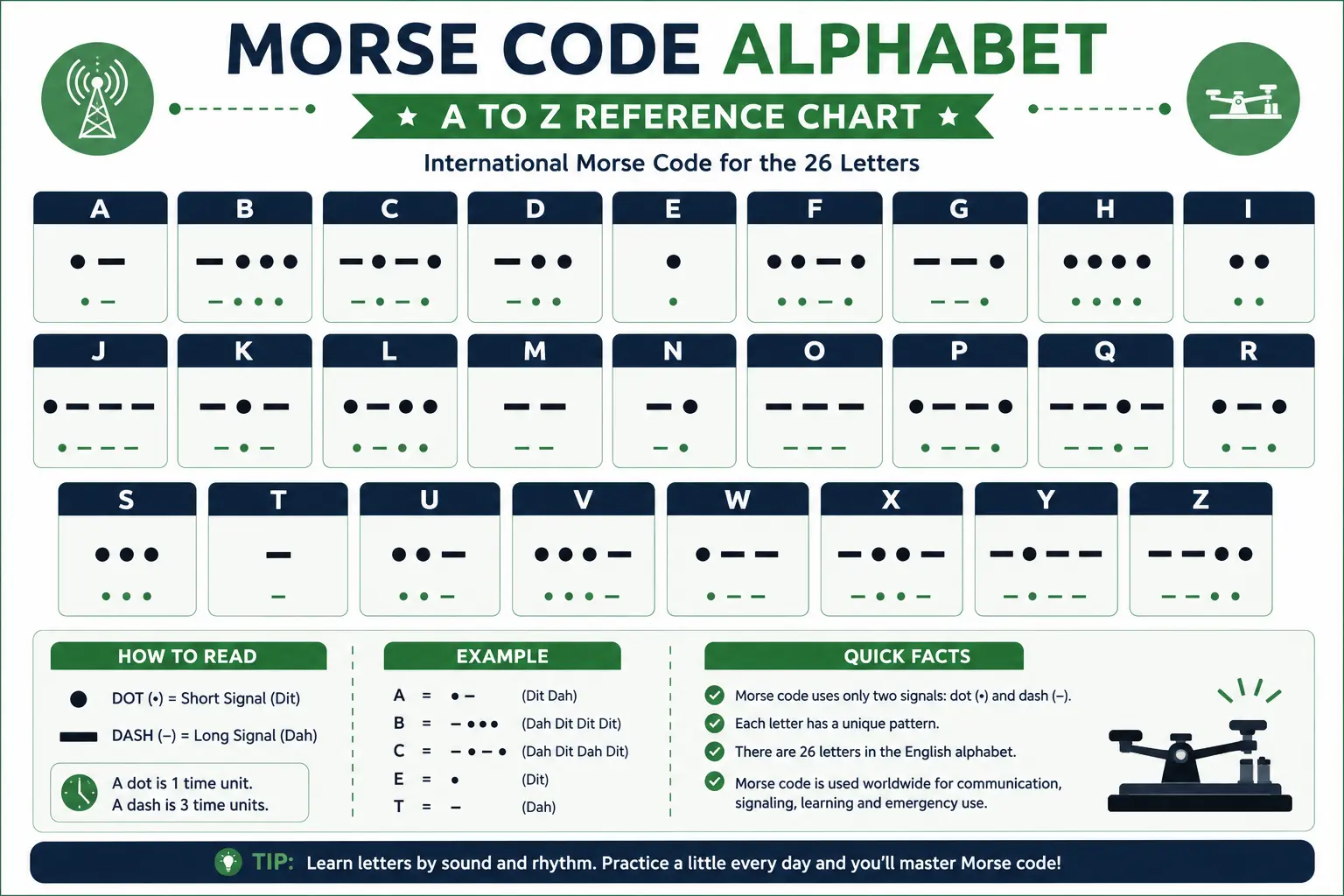
What is A in Morse Code? The Morse code for A is .-. It contains 1 dot and 1 dash.
What Is A in Morse Code?
The letter A is written as ·− in International Morse code. That pattern contains 2 elements: dit dah. It is the standard representation used in modern International Morse code, rather than one of the historical national variants. If you are learning Morse by ear, focus on the complete sound pattern instead of translating each dot and dash separately. You can test the character with the Morse Code Translator, then use the Morse Code Alphabet as a reference for the rest of the set. For a broader overview, see the Morse Code Guide.
Listen to A in Morse Code
Sound pattern: dit-dah
Sound and Rhythm
Direct answer: A sounds like dit-dah.
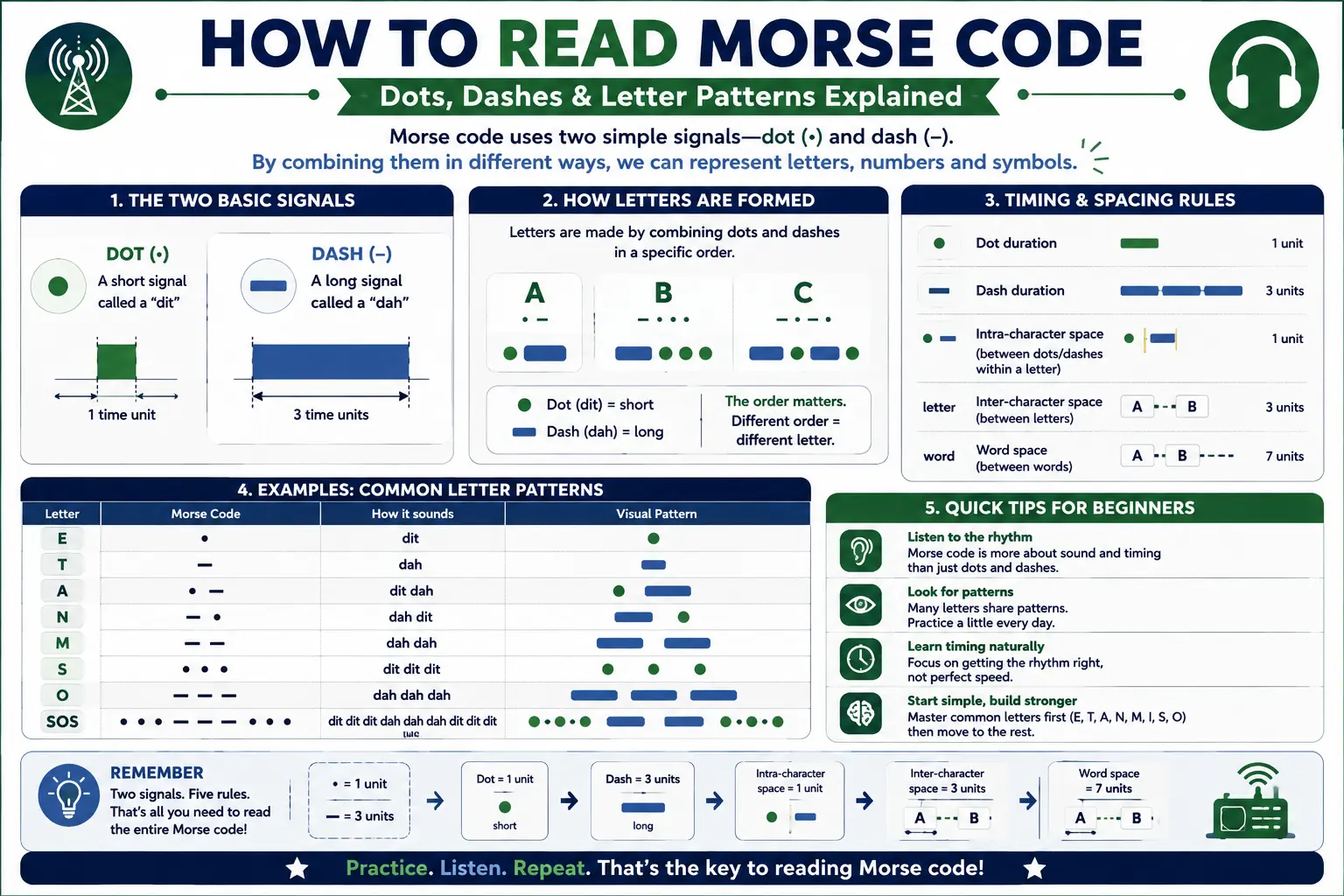
Read ·− as “dit dah.” In standard Morse timing, a dot is one time unit and a dash is three units; the gap between elements inside a character is one unit. Do not try to make the character recognizable by changing the dash-to-dot ratio. Consistent timing is what makes the pattern readable at different speeds.
How to Write and Send A
Direct answer: send .- with consistent Morse timing.
To send A, produce dit dah in this exact order: ·−. On a key, keep every dot the same length and every dash about three times as long. Keep the short gap between elements consistent, then leave a clear character gap before the next letter or number. When practicing visually with a light, use the same short/long relationship rather than copying arbitrary one-second timings.
Why A Is Important
As a letter, A is useful practice for recognizing a complete sound pattern without relying on visual counting. International Morse code is defined by the ITU-R in [Recommendation M.1677](https://www.itu.int/rec/R-REC-M.1677). For listening practice, the [ARRL Morse Code Character Sounds](https://www.arrl.org/code-characters) page provides recorded character examples. These are better reference points than unsupported historical or statistical claims that vary by source.
Visual Pattern
Visually, A is a sequence of 2 marks: ·−. A dot is the short element and a dash is the long element. When reading a Morse chart, treat the whole sequence as one character; the spaces between characters matter, but there are no spaces between the individual elements of A.
Practice A With Real Words
Practice A inside complete words instead of memorizing the character in isolation. Each example below includes the full Morse sequence and an audio button.
| Word | Morse Code | Sound | Practice Purpose |
|---|---|---|---|
| APPLE | .- .--. .--. .-.. . | Hear how A appears in a complete Morse word. | |
| ABOUT | .- -... --- ..- - | Practice recognizing A without counting every dot and dash. | |
| DATA | -.. .- - .- | Compare this sequence with the single-character rhythm above. |
How to Practice A in Morse Code
Practice A in three stages. First, send or listen to A repeatedly until its rhythm feels automatic. Second, alternate it with a contrasting character such as 9 to force your ear to identify the whole pattern. Third, use it inside words or numbers: APPLE, ABOUT, DATA. Once recognition is reliable, increase speed while keeping the character rhythm unchanged. Do not memorize the page visually and assume that means you can decode audio; ear training is a separate skill.
Listen to the complete rhythm dit-dah instead of counting individual elements.
Compare A with related characters that differ by one dot, dash, or element position.
Play the example words above and try to recognize A by sound.
Use the Morse Code Quiz to test your recognition without looking at the chart.
Key Facts About A
- In Morse, A has 2 elements: ·−.
- The spoken rhythm is commonly described as “dit dah.”
- The NATO phonetic alphabet uses “Alpha” for A.
Related Morse Code Characters
Compare similar patterns to improve recognition and avoid common Morse code mistakes.
Frequently Asked Questions About A
What is A in Morse code?
A in International Morse code is ·−, pronounced dit dah.
How do you send A in Morse code?
Send dit dah in order, keeping dots one unit long and dashes three units long, with one unit between elements.
Which Morse character is useful to compare with A?
Compare A with 9 to practice hearing the difference between complete Morse patterns. See the 9 in Morse Code page.