01
Learn the Character Sounds
Begin with a small number of characters and focus on recognizing the complete sound pattern instead of manually counting dots and dashes.
Learn how Morse code audio works through short and long tones, sound frequency, pitch, WPM, dots, dashes, character spacing, word gaps, and practical listening techniques.
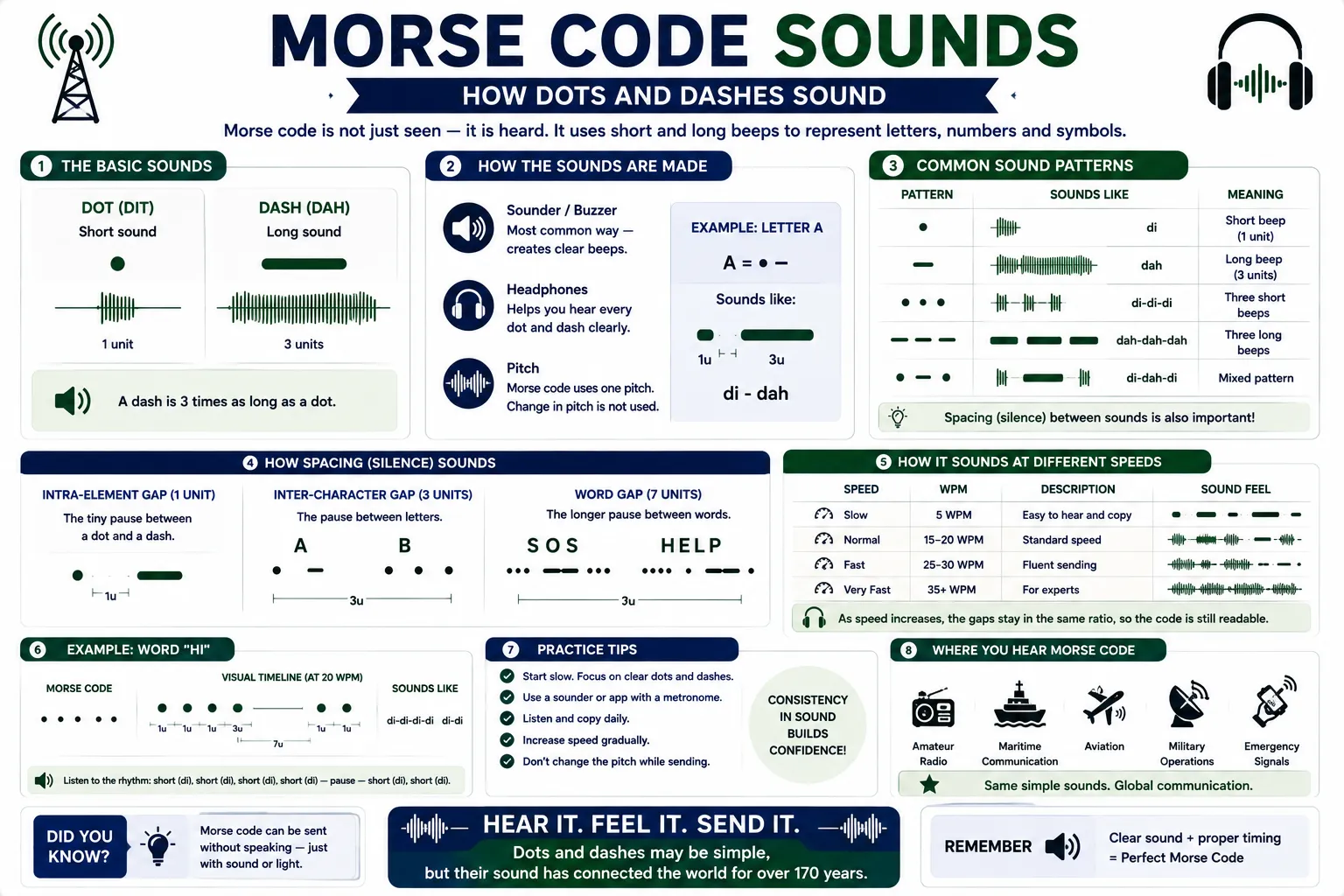
Morse code can be understood visually as dots and dashes, but its original communication system was fundamentally based on signals, timing, and rhythm. When Morse code is transmitted as audio, a short tone represents a dot, also called a dit, while a longer tone represents a dash, also called a dah.
Every character in the Morse Code Alphabet has its own pattern. For example, the letter E is represented by one short signal, while T is represented by one long signal. More complex characters combine multiple dots and dashes into recognizable audio patterns.
The goal of listening practice is not to count every dot and dash forever. With repeated exposure, experienced learners begin recognizing the overall rhythm of a character. You can generate and listen to custom messages using the Morse Code Translator, then verify unfamiliar signals with the Morse Code Decoder.
For the complete timing ratios behind these sounds, see the Morse Code Timing guide. To practice recognizing full character patterns, continue with Learn Morse Code.
Standard duration of one Morse code dot.
Standard duration of a dash and the gap between letters.
Standard timing relationship used between words.
Timing reference associated with the standard word PARIS.
The difference between a dot and dash is based primarily on duration. Correct timing is just as important as the sound itself. If the timing relationship changes too much, the listener may have difficulty identifying where one element, letter, or word ends.
A dot lasts for one timing unit. It is the shortest sound element used in International Morse Code.
A dash lasts for three timing units, making it exactly three times the duration of a standard dot.
To understand how these patterns form complete characters, browse the full A–Z Morse Code Alphabet or study Morse Code Numbers from 0–9.
Morse code does not require one fixed audio pitch. The information is carried by the pattern and timing of the signal, rather than by a specific frequency. Different radios, oscillators, software applications, and training tools can use different tones.
Many training tools let you choose a clear, comfortable tone for repeated listening. The pitch does not change the meaning of a Morse code character; the signal pattern and timing do.
You can experiment with audio playback through the Morse Code Translator, where text can be converted into Morse code and played as audio.
Morse code timing is based on a simple unit system. A dot is the fundamental measurement, and the duration of dashes and spaces is calculated relative to that dot.
Dot = approximately 60 milliseconds
Dash = approximately 180 milliseconds
Letter gap = approximately 180 milliseconds
Word gap = approximately 420 milliseconds
These values follow the standard timing relationship derived from WPM. For detailed explanations and speed calculations, visit the complete Morse Code Timing guide.
Morse code speed is commonly measured in words per minute (WPM). The word PARIS is traditionally used as a timing reference because, under standard Morse timing, it represents 50 dot units.
This creates a consistent mathematical relationship between WPM and the duration of one dot. A commonly used formula is:
At 20 WPM, this calculation gives approximately 60 milliseconds per dot. At 10 WPM, one dot is approximately 120 milliseconds. This relationship makes it possible to scale the entire Morse code timing system as speed changes.
Learning Morse code visually and learning it by sound are related but different skills. Visual study helps you understand the symbols, while listening practice develops faster recognition of the rhythm associated with each character.
Begin with a small number of characters and focus on recognizing the complete sound pattern instead of manually counting dots and dashes.
A clear timing relationship helps your brain distinguish dots, dashes, letters, and words. Practice with standard spacing whenever possible.
Start with comfortable practice sessions, then gradually increase the amount of text, character variety, or transmission speed.
Use interactive exercises to identify gaps in your knowledge and revisit characters that are difficult to recognize by ear.
For a structured learning path, continue with Learn Morse Code. Once you are comfortable with the alphabet, test your recognition using the Morse Code Quiz.
Morse code audio carries information through the sequence and timing of short and long signals. The meaning comes from the pattern, not from the musical quality or pitch of the tone. That makes timing essential when listening to or generating a Morse transmission.
For example, the letter S is ... and the letter O is ---. Together, they form the familiar SOS pattern: ... --- .... The same timing principles apply whether Morse is heard as an audio tone or represented as dots and dashes on a screen.
One of the best-known Morse patterns is SOS: ... --- .... Its simple rhythm consists of three short signals, three long signals, and three short signals.
Understanding audio also helps when decoding a message. If you hear an unfamiliar pattern, you can compare it with the Morse alphabet reference or enter the written dots and dashes into the Morse Code Decoder.
Written Morse code shows a character as dots and dashes, while audio Morse code expresses those same elements through short and long signals. In both forms, the character pattern stays the same.
Audio adds an important layer: timing. A listener needs to distinguish the length of each signal and the pauses between elements, letters, and words. This is why a message can contain the correct dots and dashes but still be difficult to recognize if the spacing is inconsistent.
If you are learning by ear, use theMorse Code Timing guide alongside theMorse Code Alphabet. This gives you both the visual pattern and the timing framework behind the sound.
Common questions about Morse code audio, tone frequency, pitch, timing, WPM, dots, dashes, spacing, and listening practice.
Morse code sounds represent short and long signal elements. A short sound is called a dot or dit, while a long sound is called a dash or dah. Different combinations form letters, numbers, punctuation, and other Morse symbols.
There is no single required audio frequency for Morse code. Training tools commonly allow the pitch to be adjusted, so learners can choose a clear and comfortable tone.
Morse code timing is measured in units. A dot lasts for 1 time unit, while a dash lasts for 3 units. At 20 WPM using standard PARIS timing, one dot unit is approximately 60 milliseconds.
A dash lasts three times as long as a dot. If one dot unit is 60 milliseconds, a dash is approximately 180 milliseconds.
The standard gap between two letters is 3 dot units. The gap between elements within the same letter is 1 dot unit, while the gap between words is 7 dot units.
PARIS is a standard reference word used to calculate Morse code speed in words per minute. Under standard timing, PARIS represents 50 dot units, allowing Morse code speed to be measured consistently.
Start by listening to individual character patterns and gradually build recognition. Avoid counting every dot and dash at higher speeds. Regular listening practice, consistent timing, and character-recognition exercises can improve auditory recognition over time.
Written Morse code displays dots and dashes visually. Audio Morse code communicates the same information using short and long tones separated by precisely timed gaps.
Yes. You can use the Morse Code Translator on this website to convert text into Morse code and use its audio playback controls to hear the corresponding Morse signals.
Yes. Although Morse code is no longer a primary method for most commercial communication, it remains relevant in amateur radio, aviation and maritime history, emergency signaling, education, accessibility discussions, and recreational communication.
Explore related tools, references, learning guides, character charts, timing explanations, and interactive practice resources.
Convert text to Morse code and listen to the generated audio.
Explore →Decode dots and dashes back into readable text.
Explore →Study the complete alphabet and individual Morse patterns.
Explore →Learn how all ten digits are represented using five signals.
Explore →Understand dots, dashes, character gaps, word gaps, and WPM.
Explore →Follow a structured approach for memorizing and recognizing Morse.
Explore →Test your knowledge and recognition of Morse code characters.
Explore →Learn why ... --- ... became the internationally recognized distress signal.
Explore →Explore the history, purpose, technology, and modern uses of Morse code.
Explore →Convert your own message into International Morse Code, listen to the dots and dashes, adjust the playback settings, and build your recognition skills through practical listening.