Morse Code Timing: WPM, Speed & Spacing
Understand Morse code timing, WPM speed, dot and dash duration, character spacing, word gaps, the PARIS 50-unit reference, and the Farnsworth timing method.
How Morse Code Timing Works
Morse code is more than a collection of dots and dashes. The relationship between signal lengths and silent gaps is part of the communication system itself. Timing tells a listener where one signal element ends, where a character ends, and where a word begins. A correctly transmitted message uses proportional timing so that a listener can distinguish individual elements, characters, and words.
International Morse Code is defined by the International Telecommunication Union in ITU-R M.1677. The practical timing model is based on a simple unit system: a dot equals one unit and all other elements are measured as multiples of that unit.
If you are learning the actual character patterns, start with the Morse Code Alphabet. You can then use the Morse Code Translator to convert messages and the Morse Code Sounds page to hear how different characters are transmitted.
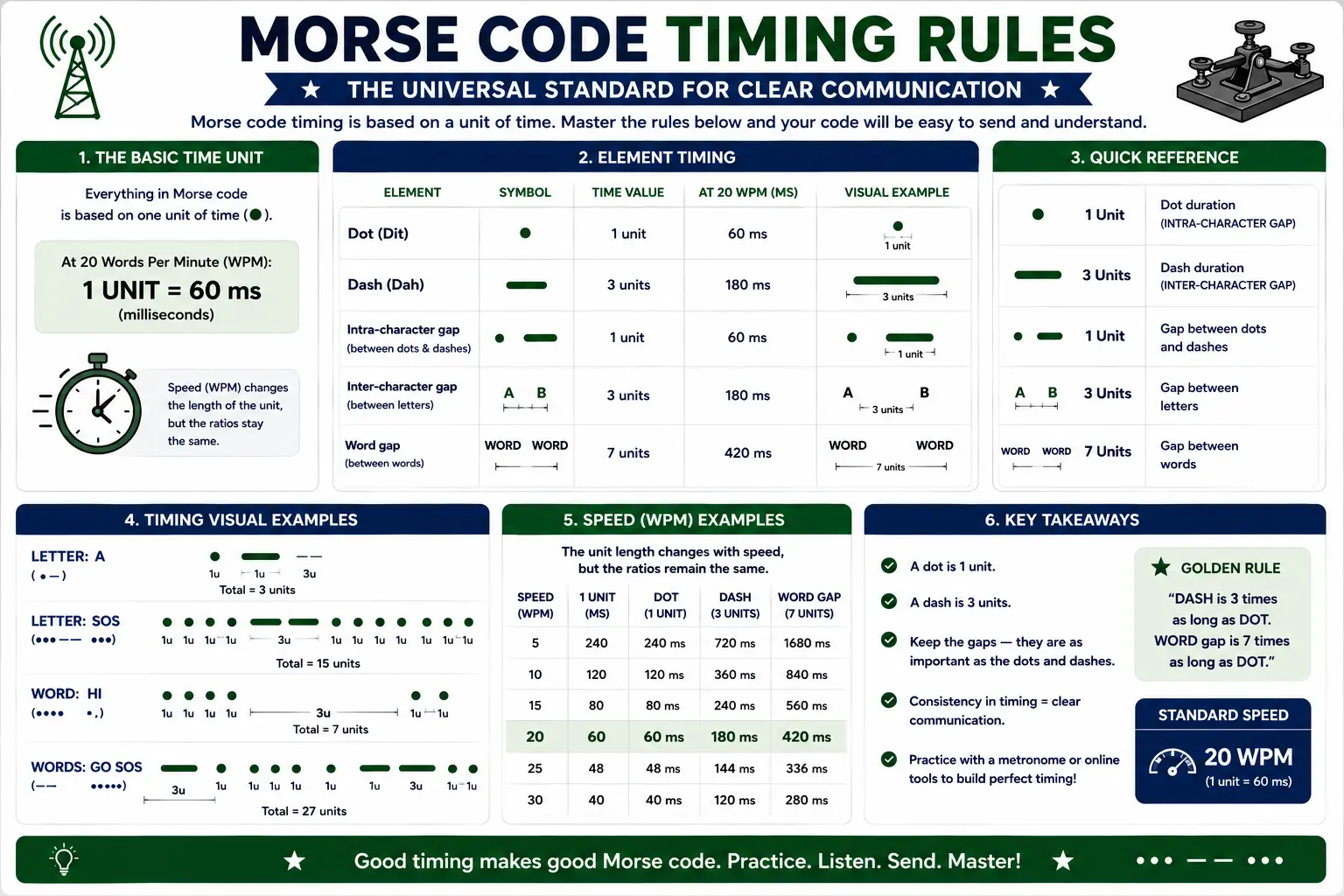
The 1–3–1–3–7 Morse Code Timing Rule
Standard Morse timing uses five important proportional durations. Once you understand these values, you can calculate the timing for any WPM speed.
Dot
1 Unit
The basic timing reference.
Dash
3 Units
Three times the dot duration.
Inside Character
1 Unit
Gap between dots and dashes.
Between Letters
3 Units
Gap separating characters.
Between Words
7 Units
The standard word space.
Why the Ratios Matter
At 20 WPM, one timing unit equals 60 milliseconds. Therefore, a dash lasts 180 milliseconds, the character gap is 180 milliseconds, and the word gap is 420 milliseconds. When the transmission speed changes, these durations scale proportionally.
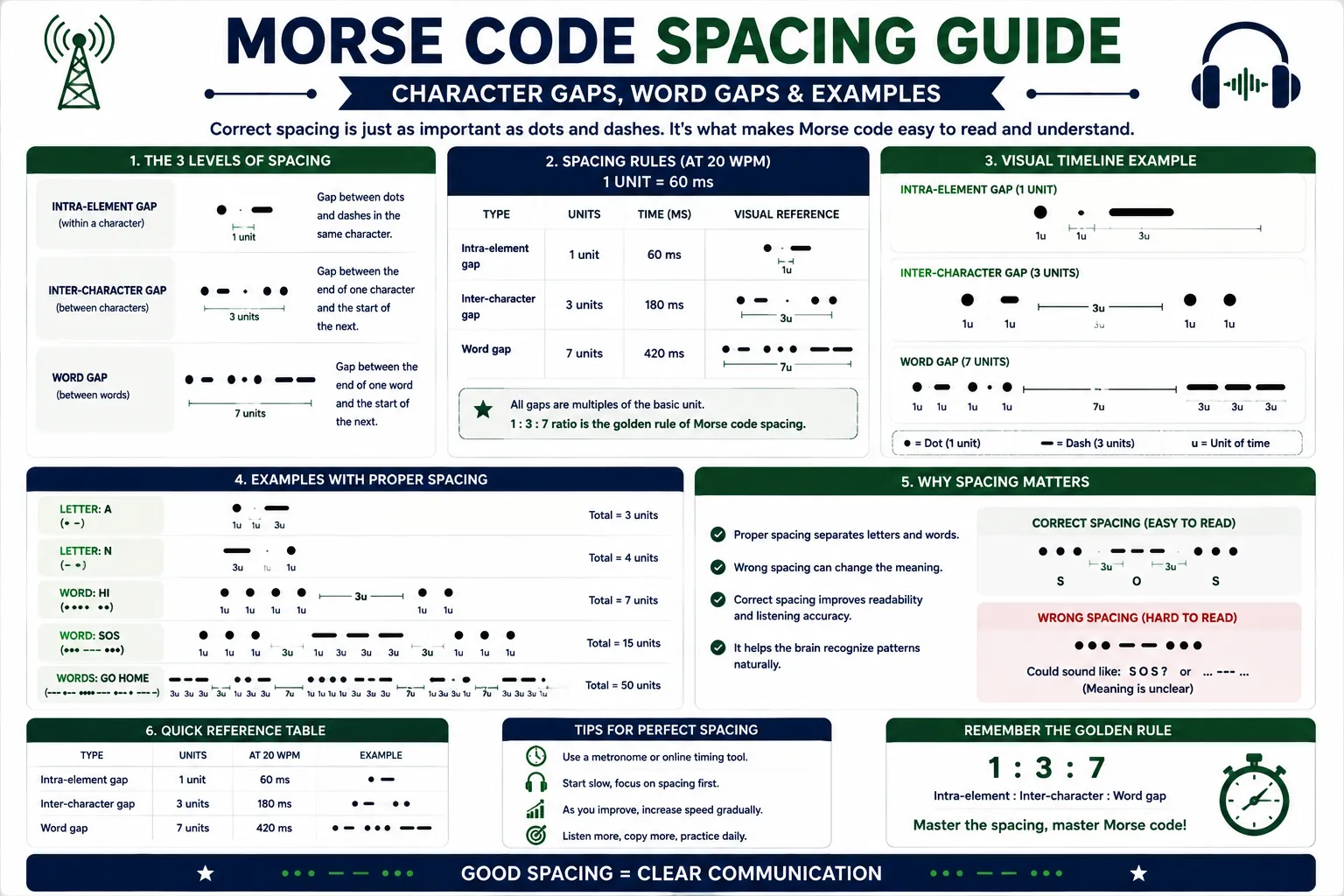
For practical listening exercises, open Morse Code Sounds or use the Morse Code Translator to generate your own practice messages.
Morse Code WPM Calculator
Change the WPM value to calculate the exact duration of a dot, dash, character gap, and word gap.
60ms
Dot
180ms
Dash
60ms
Inside Character
180ms
Letter Gap
420ms
Word Gap
How to Calculate Morse Code Timing
Morse speed is commonly calculated using the reference word PARIS, which represents 50 timing units under the standard measurement convention.
Dot duration formula
1200 ÷ WPM = milliseconds
Example: at 20 WPM, 1200 ÷ 20 = 60 milliseconds per dot. Every other timing value is then calculated from that fundamental duration.
Quick Example at 20 WPM
Morse Code WPM Timing Chart
This reference table shows calculated timing values at common Morse code speeds. The values use the standard formula of 1200 divided by WPM for one dot duration.
| Speed | Dot | Dash | Inside Character | Letter Gap | Word Gap | Practice Use |
|---|---|---|---|---|---|---|
| 5 WPM | 240 ms | 720 ms | 240 ms | 720 ms | 1680 ms | Slow practice |
| 10 WPM | 120 ms | 360 ms | 120 ms | 360 ms | 840 ms | Beginner practice |
| 15 WPM | 80 ms | 240 ms | 80 ms | 240 ms | 560 ms | Moderate practice |
| 20 WPM | 60 ms | 180 ms | 60 ms | 180 ms | 420 ms | Common practice speed |
| 25 WPM | 48 ms | 144 ms | 48 ms | 144 ms | 336 ms | Fast practice |
| 30 WPM | 40 ms | 120 ms | 40 ms | 120 ms | 280 ms | Advanced practice |
Farnsworth Timing Method Explained
Farnsworth timing is designed to help learners recognize the sound pattern of complete Morse characters. Instead of slowing down every dot and dash, the character itself can be sent at a higher character speed while additional space is inserted between letters and words.
Standard Timing
At standard timing, the entire message scales according to the selected WPM. Lower speed means longer dots, longer dashes, and longer standard gaps.
Farnsworth Timing
Individual characters retain their selected internal rhythm, while extra delay is added between characters and words to reduce the overall message speed.
To combine timing practice with character recognition, use the Learn Morse Code guide. After practicing, test your recognition speed with the Morse Code Quiz.
Continue Learning Morse Code
Explore related tools and guides for translation, decoding, character recognition, audio practice, numbers, SOS signals, and Morse code learning.
Morse Code Translator
Convert text to Morse and Morse back to readable text.
Explore🔓Morse Code Decoder
Decode dots and dashes with character analysis.
Explore📋Morse Code Alphabet
Study all A–Z Morse code character patterns.
Explore🔢Morse Code Numbers
Learn how the digits 0 through 9 are represented.
Explore🔊Morse Code Sounds
Listen to Morse signals and practice recognition.
Explore📖Learn Morse Code
Follow a structured path for learning Morse code.
Explore🎯Morse Code Quiz
Test your knowledge with interactive questions.
Explore🆘SOS Signal in Morse Code
Understand the SOS signal, its Morse pattern, and common emergency-signal context.
Explore📚What Is Morse Code?
Explore the history, purpose, and modern uses of Morse.
ExploreMorse Code Timing References
The timing ratios on this page describe standard International Morse Code practice. For authoritative reference material, consult the International Telecommunication Union recommendation and established amateur-radio resources.
Morse Code Timing FAQ
Common questions about Morse code speed, WPM calculation, timing ratios, dot duration, word spacing, and Farnsworth practice.
Put Morse Code Timing Into Practice
Use the translator to send messages, practice listening to Morse sounds, study the alphabet, and test your recognition skills with interactive exercises.