What is Morse Code?
Learn what Morse code is, how dots and dashes represent letters and numbers, why timing matters, how the code developed alongside the electric telegraph, and where it is still useful today. This guide combines the basic idea, history, timing rules, practical uses, and beginner-friendly resources in one place.
Understanding Morse Code
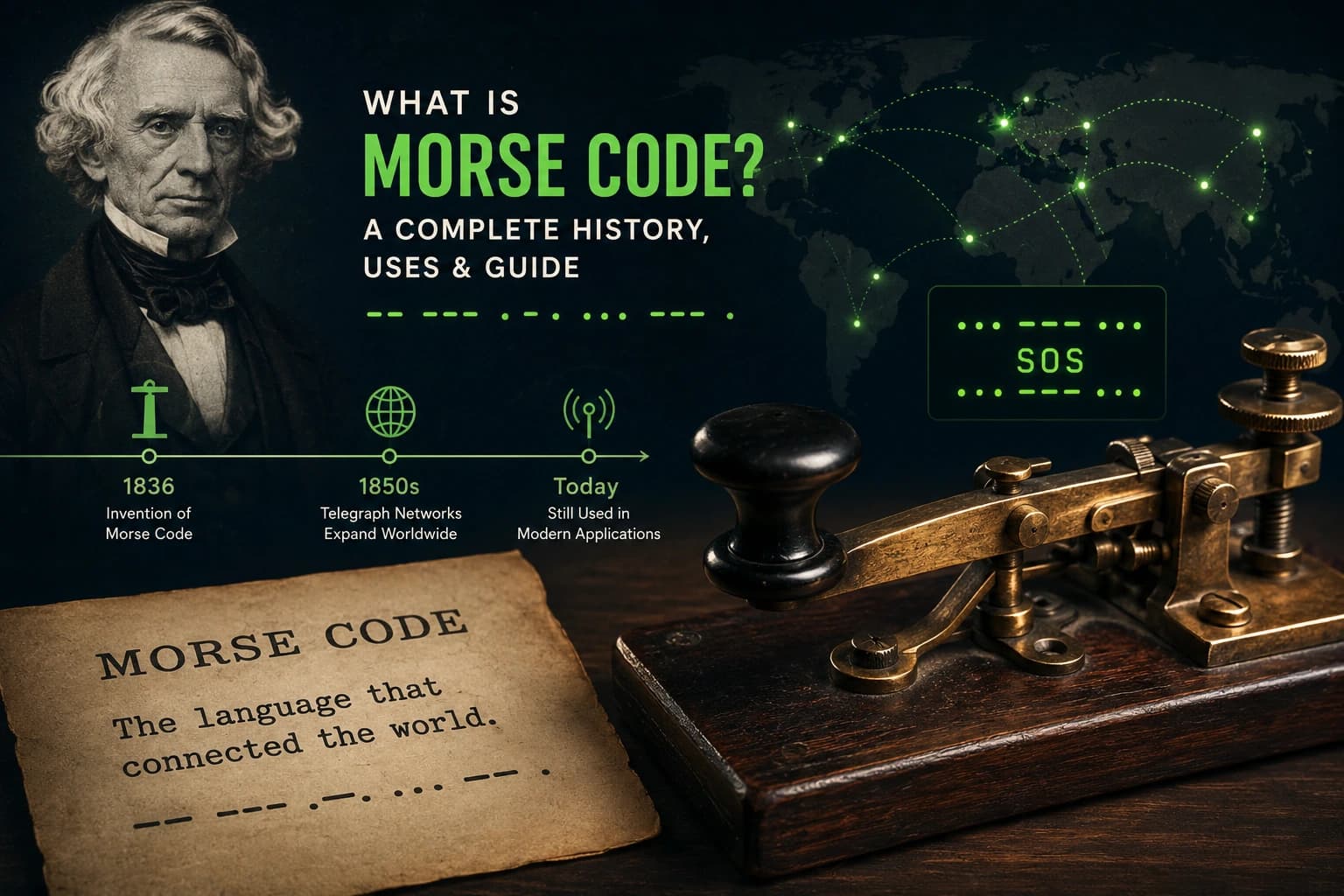
Morse code is a method of telecommunication that encodes text characters as standardized sequences of two different signal durations, called dots (or "dit") and dashes (or "dah"). Developed in the early 1830s, it was the primary means of long-distance electrical communication for over a century and remains in active use today.
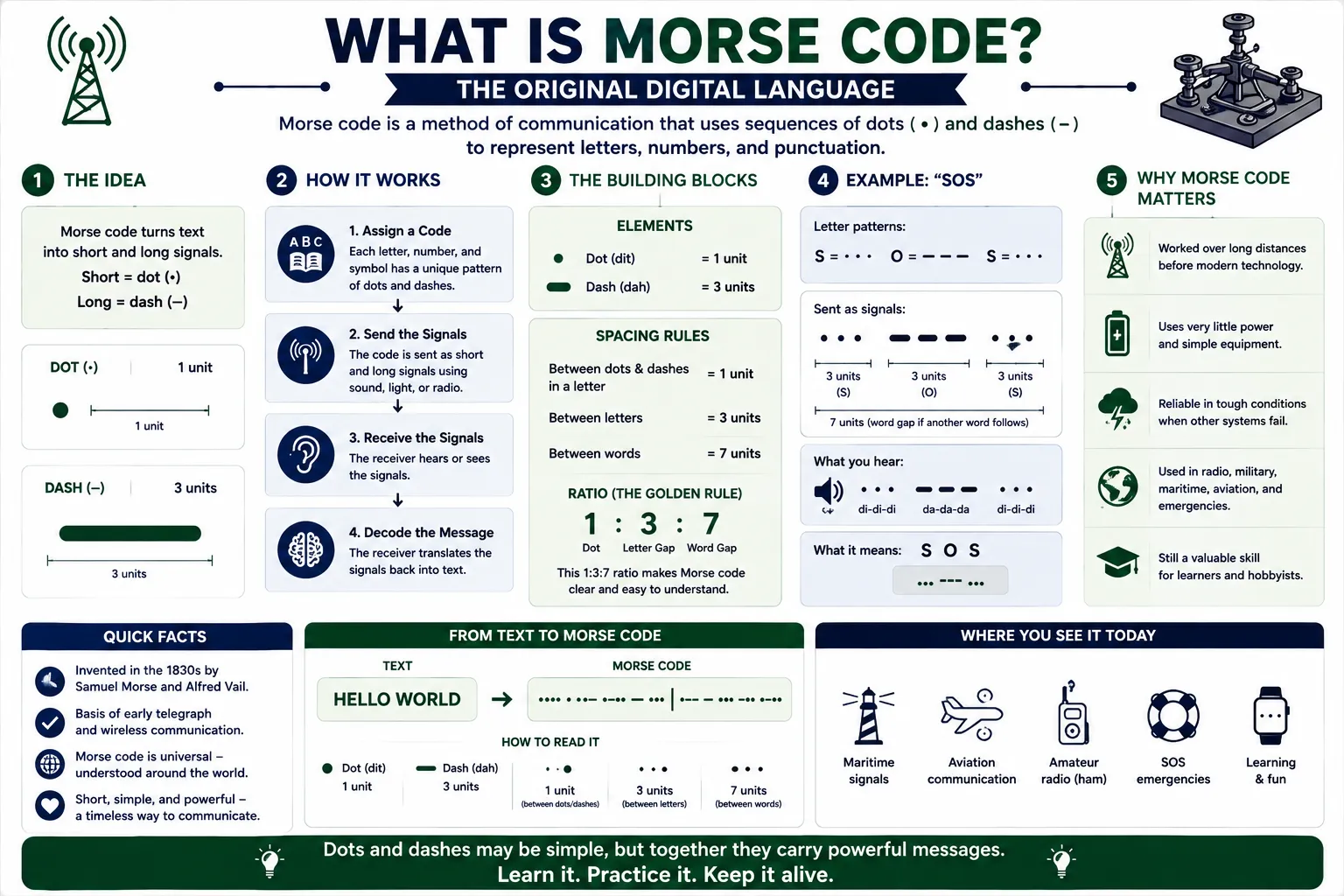
At its core, Morse code uses two signal elements: a short one (dot) and a long one (dash). The order and number of dots and dashes determines which character is being transmitted. For example, a single dot represents the letter E, while a single dash represents the letter T. The letter A is dot-dash, the letter B is dash-dot-dot-dot, and so on for all 26 letters of the Morse code alphabet, 10 numerals, and various punctuation marks.
One reason Morse code can be efficient is that common characters can be represented with short patterns. E is a single dot and T is a single dash, while less frequent letters generally use longer patterns. This unequal code length reduces the average amount of signaling needed for ordinary text compared with a system in which every character has the same-length representation.
If you want to see how Morse code works in practice, try our Morse Code Decoder to convert real Morse code messages back into readable text, or use our Morse Code Translator to instantly encode your own messages.
For a complete character reference, explore the Morse Code Alphabet and Morse Code Numbers. If you want hands-on practice, use the Morse Code Translator to encode or decode your own message.
Morse Code at a Glance
Dots & dashes
Characters are built from short and long signals arranged in specific patterns.
Timing matters
The spaces within characters, between characters, and between words are part of the code.
International standard
International Morse code is documented in ITU-R Recommendation M.1677-1.
How Morse Code Works
Morse code transmission relies on precise timing relationships between signals. The fundamental unit of time is the dot duration, and all other timings are measured relative to it:
- Dot (dit) — 1 unit of time
- Dash (dah) — 3 units of time
- Space between parts of the same letter — 1 unit
- Space between letters — 3 units
- Space between words — 7 units
These timing rules are what make Morse code intelligible. Without proper spacing, it would be impossible to distinguish between, for example, the letter I (two dots) and the letter A (dot-dash), or between five separate E's and the number 5 (five dots). Speed is measured in words per minute (WPM), where one "word" is standardized as 50 dot units (based on the word "PARIS").
Morse code can be transmitted through multiple media: electrical pulses (as in the original telegraph), audio tones (short and long beeps), light signals (short and long flashes), visual signals (flags), and even physical taps. This versatility is one reason Morse code has remained useful across so many different contexts and technologies. You can hear the difference between dots and dashes on our Morse code sounds page, and learn the precise timing rules on our Morse code timing reference.
The History of Morse Code
The story of Morse code begins with Samuel Finley Breese Morse (1791–1872), an American painter and inventor. While returning from a trip to Europe in 1832, Morse overheard a conversation about electromagnetism and became fascinated with the idea of using electricity to transmit messages. Over the next several years, he developed the electrical telegraph and the code that would bear his name.
Morse's assistant, Alfred Vail, played a crucial role in refining both the telegraph hardware and the code itself. Vail made major contributions to the telegraph and to the alphabet used with it. Smithsonian archival material documents his role in improving the equipment and replacing Morse's earlier numerical system with a more practical alphabetic code. His work helped make messages faster and easier to decode.
The first demonstration of the telegraph occurred on January 6, 1838, at Morristown, New Jersey. But the truly historic moment came on May 24, 1844, when Morse sent the first official telegraph message from the Supreme Court chamber in the U.S. Capitol to the B&O Railroad depot in Baltimore, Maryland. The message — "What hath God wrought?" — chosen by Annie Ellsworth, the daughter of Morse's friend, was a quotation from the Bible (Numbers 23:23).
Within a decade, telegraph lines crisscrossed the United States and Europe. The Transatlantic telegraph cable of 1858 connected Europe and North America for the first time, shrinking the world dramatically. By the 1860s, the International Morse Code (a refined version of Morse and Vail's original) was standardized and adopted worldwide at the International Telegraph Conference in 1865.
If you want to go beyond the history and start learning Morse code yourself, follow our step-by-step Morse code learning guide.
From Painter to Telegraph Pioneer
Samuel Finley Breese Morse was trained as a painter before becoming closely associated with the electric telegraph. During a sea voyage in 1832, a conversation about electromagnetism helped spark his interest in transmitting information with electricity. He continued developing the idea while maintaining his career in the arts.
Morse's work became much more practical through his partnership with Alfred Vail. Vail contributed to the telegraph apparatus and helped refine the coding approach used to represent individual characters. The collaboration was important in turning an experimental concept into a workable communication system.
The Telegraph Changed Long-Distance Communication
The successful Washington-to-Baltimore demonstration showed that electrical messages could cross a long distance far faster than physical mail. Telegraph networks then expanded alongside railroads and became important to business, journalism, government, and personal communication.
Telegraphy also spread internationally. Undersea cable projects eventually connected continents, helping create a global communications network. During the American Civil War, telegraph lines were used for military communication, demonstrating how quickly information could be moved over long distances.
American Morse vs. International Morse Code
The original American Morse system and the later International Morse Code are related but not identical. American Morse, sometimes called Railroad Morse, was used extensively in the United States and had some different character and spacing conventions.
International Morse Code was standardized for international telegraph communication in the 19th century and became the form most commonly referenced today. Its standardized timing and character patterns support communication across different countries and applications. For the current technical reference, seeITU-R Recommendation M.1677.
Timeline of Key Events
Samuel Morse conceives the idea of the electromagnetic telegraph during a transatlantic voyage.
Morse files a patent for the telegraph. Alfred Vail begins assisting with development.
First public demonstration of the telegraph at Morristown, New Jersey.
The first official telegraph message 'What hath God wrought?' is sent from Washington to Baltimore on May 24.
A telegraph line is established between London and Paris, connecting Britain to continental Europe.
The first transatlantic telegraph cable is laid, connecting North America and Europe.
The International Telegraph Conference standardizes International Morse Code.
SOS is adopted as the international distress signal at the Berlin Radio Conference.
The RMS Titanic sinks; its SOS calls help save 706 passengers and revolutionize maritime safety.
Morse code is used extensively during World War I for military communications.
Ludwig Koch develops the Koch method for teaching Morse code, still used today.
Morse code requirements for amateur radio licenses are relaxed in many countries.
The International Maritime Organization ends Morse code requirements for ships.
Morse code remains in use in areas such as amateur radio, signaling, education, and some assistive communication systems.
The Decline of Commercial Telegraphy and Morse Code's Legacy
Telephone networks, teletype systems, and later digital communications gradually reduced the need for commercial Morse telegraphy. Even though the original telegraph infrastructure is largely a historical technology, the code itself survived because it is simple, adaptable, and can be transmitted through sound, light, radio, or physical signals.
Morse code also has a lasting cultural and educational role. It appears in historical collections, communications training, amateur radio, films, literature, and other forms of popular culture. Its simple dot-and-dash structure makes it an enduring example of how information can be represented with a small set of signal elements.
Modern Applications
While the telegraph has largely been replaced by newer technologies, Morse code itself is far from obsolete. It continues to serve important roles in several fields:
📡 Amateur Radio
Ham radio operators worldwide use Morse code (CW mode) for long-distance communication that can span the globe on very low power. Morse code signals can penetrate noise and interference better than voice signals. If you want to practice character recognition, try our Morse Code Quiz.
✈️ Aviation
Some radio navigation aids use Morse identifiers so operators can identify a station by its transmitted signal. The exact navigation systems and procedures depend on the equipment and aviation rules in use.
🚢 Maritime
Modern maritime communication relies mainly on digital and voice systems, but Morse code remains historically important and is still familiar as a distress-signaling method. For real emergencies, use current approved maritime procedures and equipment.
♿ Assistive Technology
Morse code can be adapted as a simple input method for people who have limited movement or speech. Assistive systems can map dot-and-dash choices to letters, commands, or other computer inputs.
🎯 Emergency Signaling
SOS is widely recognized as a distress signal and can be represented in Morse code as three dots, three dashes, and three dots. Read our SOS signal and Morse code guide for its history and signaling methods. In a real emergency, follow local emergency guidance and use appropriate approved equipment.
🎓 Education & Culture
Morse code is taught in military academies, scouting programs, and engineering schools worldwide. It appears in films, music, and literature, and is recognized as intangible cultural heritage in several countries.
Morse Code References
For technical standards and historical background, these external resources provide useful context from authoritative organizations. They open in a new tab so you can compare the source material with this guide.
ITU-R M.1677
International Morse code recommendation and technical reference.
Smithsonian: Morse & Vail
Historical background on Samuel Morse, Alfred Vail, and the early telegraph.
ARRL Code Characters
A practical reference for International Morse code characters used in amateur radio.
External references are provided for further reading and technical context. They are independent of Morse Code Translator and may contain information, standards, or policies that change over time.
Frequently Asked Questions
What is Morse code?+
Morse code is a communication system that represents letters, numbers, and some punctuation with patterns of short and long signals, called dots and dashes, separated by specific timing gaps.
Who invented Morse code?+
Samuel F. B. Morse and Alfred Vail developed the telegraph system and the code used with it in the 1830s and 1840s. Vail made important contributions to the practical alphabetic code and telegraph equipment.
Is Morse code still used today?+
Yes. Morse code remains in use in amateur radio and other signaling, educational, historical, and assistive communication contexts. International Morse code is also documented by ITU-R Recommendation M.1677-1.
How does Morse code work?+
Each character is represented by a pattern of dots and dashes. Timing also matters: a dot is one unit, a dash is three units, the gap within a character is one unit, the gap between characters is three units, and the gap between words is seven units.
What was the first Morse code message?+
On May 24, 1844, the message 'What hath God wrought?' was transmitted from Washington, D.C. to Baltimore over the experimental telegraph line.