Morse Code Quiz: 50 Questions to Test Your Knowledge
50 quiz questions organized by difficulty from beginner to expert, covering letters, numbers, phrases, history, timing, and Morse code trivia with answers provided.
Written and reviewed by
Morse Code Translator TeamOur editorial team researches, writes, and reviews content to provide clear and accurate information about Morse code, communication standards, learning methods, and related topics.
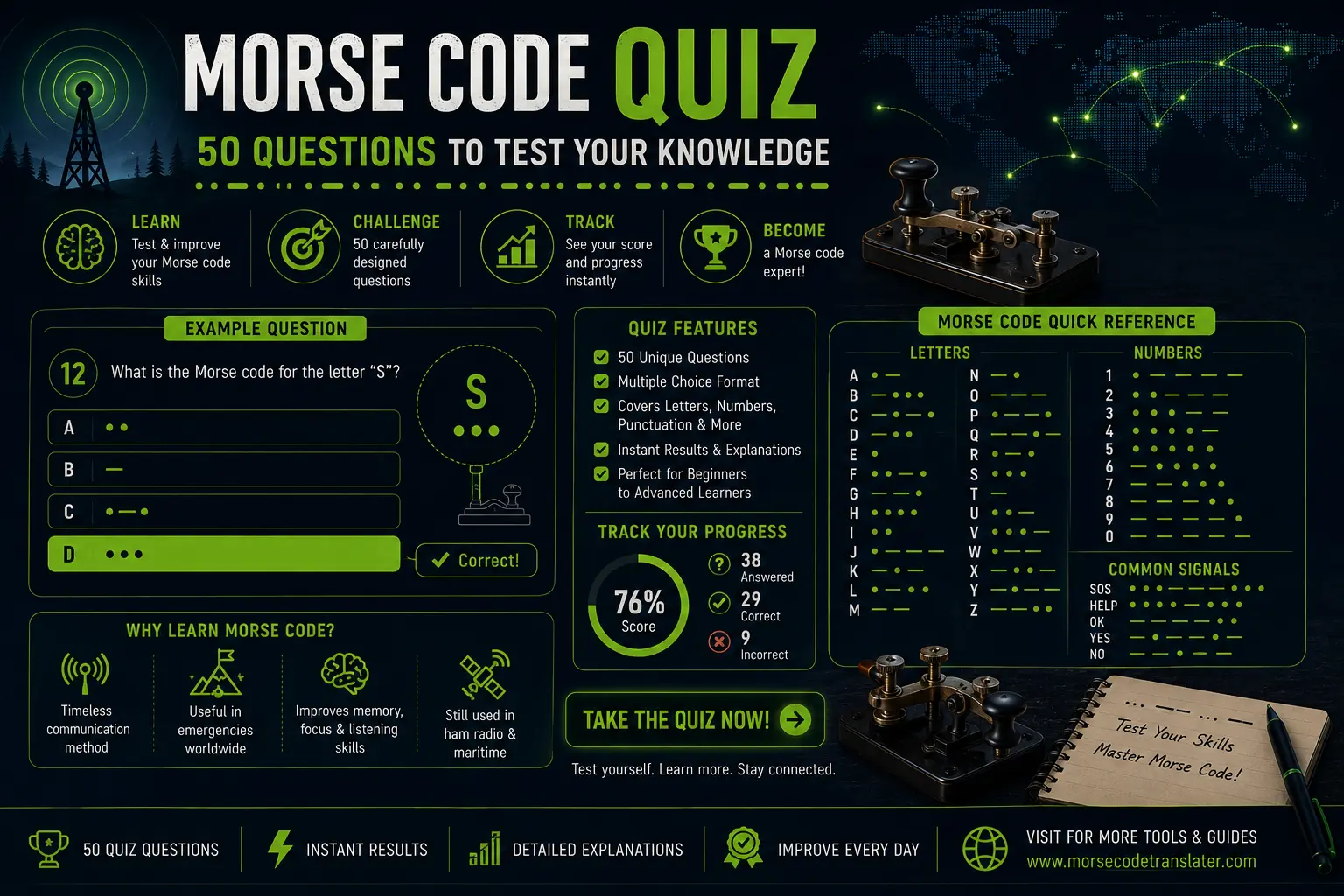
Think you know Morse code? This comprehensive quiz will put your knowledge to the test with 50 questions spanning three difficulty levels. If you need to review the characters first, use our Morse Code Alphabet reference; for timing questions, our Morse Code Timing Guide covers the underlying rules. Whether you are a beginner just learning the basics or an experienced operator looking to challenge yourself, these questions cover everything from character recognition to history and technical knowledge.
Grab a pen and paper, and do not scroll to the answers until you have completed the questions!
Beginner Level (Questions 1-20)
These questions cover the basics: the most common letters, simple numbers, and fundamental Morse code facts.
- 1What is the Morse code for the letter E?
- 2What is the Morse code for the letter T?
- 3What is the Morse code for the letter A?
- 4What is the Morse code for the letter S?
- 5What is the Morse code for the letter O?
- 6What is the Morse code for the letter N?
- 7What is the Morse code for the letter H?
- 8What is the Morse code for the letter I?
- 9How many dots is the number 5 in Morse code?
- 10How many dashes is the number 0 in Morse code?
- 11What is the SOS distress signal in Morse code? See the SOS Morse Code Guide if you need to review it before answering.
- 12What is the Morse code for the letter K?
- 13What is the Morse code for the letter M?
- 14What is the Morse code for the letter R?
- 15What is the Morse code for the letter U?
- 16What is the Morse code for the letter W?
- 17How many elements (dots and dashes) make up the letter C?
- 18What is the most common letter in English, and what is its Morse code?
- 19True or false: Morse code was invented by Samuel Morse alone.
- 20What year was the first official Morse code message sent?
Intermediate Level (Questions 21-35)
These questions require more detailed knowledge of the full character set, common phrases, and Morse code concepts.
- 1What is the Morse code for the letter Q?
- 2What is the Morse code for the letter X?
- 3What is the Morse code for the letter Y?
- 4What is the Morse code for the letter Z?
- 5What is the Morse code for the letter J?
- 6What is the Morse code for the letter F?
- 7What is the Morse code for the letter P?
- 8What is the Morse code for the number 7?
- 9What is the Morse code for the number 3?
- 10What is the Morse code for a period (.)?
- 11What is the Morse code for a comma (,)?
- 12What is the Morse code for a question mark (?)?
- 13What are the three letters of the distress signal SOS, each individually?
- 14What is the prosign for “end of transmission”?
- 15What is the Koch method used for in Morse code learning?
Expert Level (Questions 36-50)
These questions cover history, technical details, timing rules, and advanced Morse code knowledge.
- 1How long is a dash compared to a dot in standard Morse code timing?
- 2How many timing units is the space between letters?
- 3How many timing units is the space between words?
- 4What standard word is used to measure Morse code speed in WPM?
- 5How many timing units does the standard speed reference word contain?
- 6What was the first message sent by Morse code, and in what year?
- 7Who was Alfred Vail and what was his contribution to Morse code?
- 8What was the last year Western Union sent a commercial Morse code telegram?
- 9What is the Farnsworth method, and why is it useful?
- 10What does “CW” stand for in amateur radio, and what mode does it refer to?
- 11What was the significance of the International Telegraph Conference of 1865?
- 12How do pilots use Morse code in modern aviation?
- 13What is the difference between American Morse Code and International Morse Code?
- 14What is the typical speed range for a skilled amateur radio CW operator?
- 15What year did the Titanic sink, and what distress signals were sent?
---
---
Answers
Beginner Level Answers
- 1E = · (one dot)
- 2T = — (one dash)
- 3A = ·— (dot-dash)
- 4S = ··· (three dots)
- 5O = ——— (three dashes)
- 6N = —· (dash-dot)
- 7H = ···· (four dots)
- 8I = ·· (two dots)
- 9Five dots (· · · · ·)
- 10Five dashes (——— ——— ——— ——— ———)
- 11··· ——— ··· (three dots, three dashes, three dots)
- 12K = —·— (dash-dot-dash)
- 13M = —— (two dashes)
- 14R = ·—· (dot-dash-dot)
- 15U = ··— (two dots, one dash)
- 16W = ·—— (dot-dash-dash)
- 17Four elements: —·—· (dash-dot-dash-dot)
- 18E, represented by a single dot (·)
- 19False. While Samuel Morse patented the telegraph, Alfred Vail made significant contributions to both the hardware and the coding system.
- 201844 — May 24, 1844, to be exact.
Intermediate Level Answers
- 1Q = ——·— (two dashes, dot, dash)
- 2X = —··— (dash, two dots, dash)
- 3Y = —·——— (dash, dot, two dashes)
- 4Z = ——·· (two dashes, two dots)
- 5J = ·——— (dot, three dashes)
- 6F = ··—· (two dots, dash, dot)
- 7P = ·——· (dot, two dashes, dot)
- 87 = ———·· (three dashes, two dots)
- 93 = ···—— (three dots, two dashes)
- 10Period (.) = ·—·—·—
- 11Comma (,) = ——··——
- 12Question mark (?) = ··————··
- 13S (···), O (———), S (···)
- 14AR (·—·—)
- 15The Koch method is a progressive training technique where you learn one new character at a time at full speed, adding a new character only when you achieve 90% accuracy on the current set.
Expert Level Answers
- 1A dash is exactly 3 times the length of a dot.
- 2The space between letters is 3 timing units (equal to one dash).
- 3The space between words is 7 timing units.
- 4The standard word is “PARIS.”
- 550 timing units. One WPM equals 50 timing units per minute.
- 6“What hath God wrought” — sent on May 24, 1844.
- 7Alfred Vail was Samuel Morse's partner who contributed significantly to the telegraph hardware design and developed the more efficient letter-based code system. Many historians credit him as a co-developer of Morse code.
- 8January 27, 2006.
- 9The Farnsworth method sends individual characters at a high speed (e.g., 15-20 WPM) while increasing the gaps between characters to lower the effective speed. This preserves the rhythmic character pattern while giving learners more time to process each character.
- 10CW stands for Continuous Wave. It refers to Morse code transmission using a steady radio frequency carrier wave that is turned on and off to create dots and dashes.
- 11The 1865 International Telegraph Conference in Berlin established the first international standards for telegraphy, including the standardized International Morse Code that is still used today.
- 12Pilots use Morse code to identify VOR (VHF Omnidirectional Range) and NDB (Non-Directional Beacon) navigation stations. Each station transmits a three-letter Morse code identifier that pilots must be able to decode to confirm they are on the correct frequency.
- 13American Morse Code (also called Railroad Morse) was the original system with some irregular character patterns designed for speed. International Morse Code, standardized in 1865, regularized the patterns (all dashes are exactly 3 units) for international compatibility. International Morse Code is the standard used worldwide today.
- 14Typical skilled CW operators work at 15-25 WPM for general communication. Expert operators can reach 30-40+ WPM, and the world record holders have exceeded 75 WPM.
- 15The Titanic sank on April 15, 1912. The wireless operators sent both the old distress signal CQD and the newer SOS signal.
How Did You Score?
- 0-15 correct: Beginner — Review the character basics and practice before retaking the quiz.
- 16-30 correct: Intermediate — You have a solid understanding of Morse code. Practice regularly to fill in gaps.
- 31-40 correct: Advanced — Impressive knowledge! You clearly have serious Morse code experience.
- 41-50 correct: Expert — You are a true Morse code master! Your knowledge spans history, technique, and practical application.
Use this quiz as a benchmark to track your progress as you continue learning.
Keep Learning
Related Articles
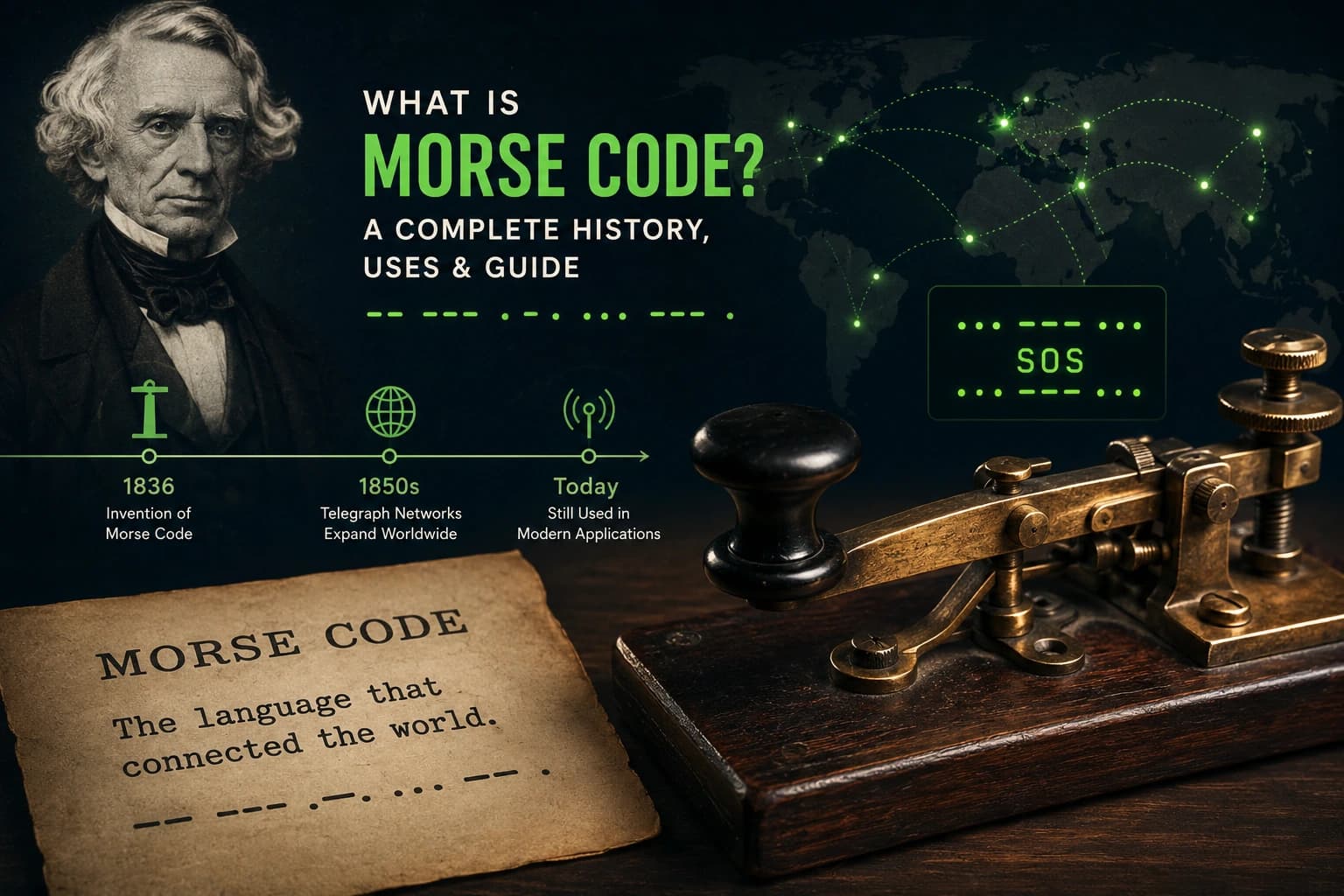
What is Morse Code? Complete History & Guide (2025)
Discover the fascinating history of Morse code from Samuel Morse's invention in 1836 to modern-day applications in emergency signaling, amateur radio, and assistive technology. A complete guide for 2025.
How to Learn Morse Code: 7 Proven Steps for Beginners
A step-by-step guide to learning Morse code from scratch using proven methods like the Koch method, Farnsworth timing, mnemonics, and daily practice routines.
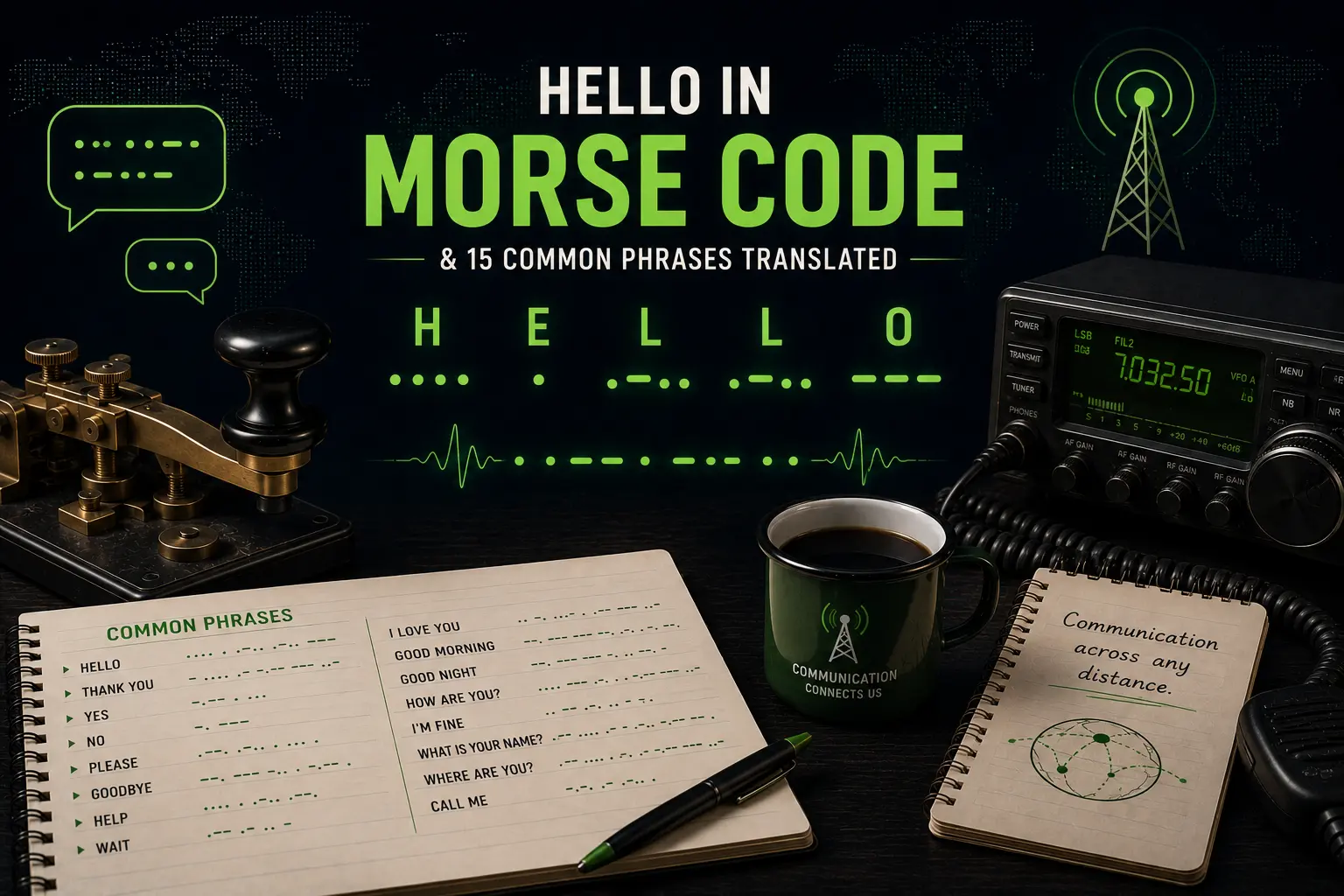
Hello in Morse Code & 15 Common Phrases Translated
Complete translation of HELLO in Morse code plus 15 common phrases including OK, HELP, YES, NO, LOVE, GOODBYE, PLEASE, THANK YOU, SORRY, WELCOME, and more with full breakdowns.