Morse Code Timing Rules: Dots, Dashes & WPM Explained
Complete guide to Morse code timing rules including the PARIS standard, dot/dash ratios, timing units, WPM calculation, Farnsworth method, and professional speed standards.
Written and reviewed by
Morse Code Translator TeamOur editorial team researches, writes, and reviews content to provide clear and accurate information about Morse code, communication standards, learning methods, and related topics.
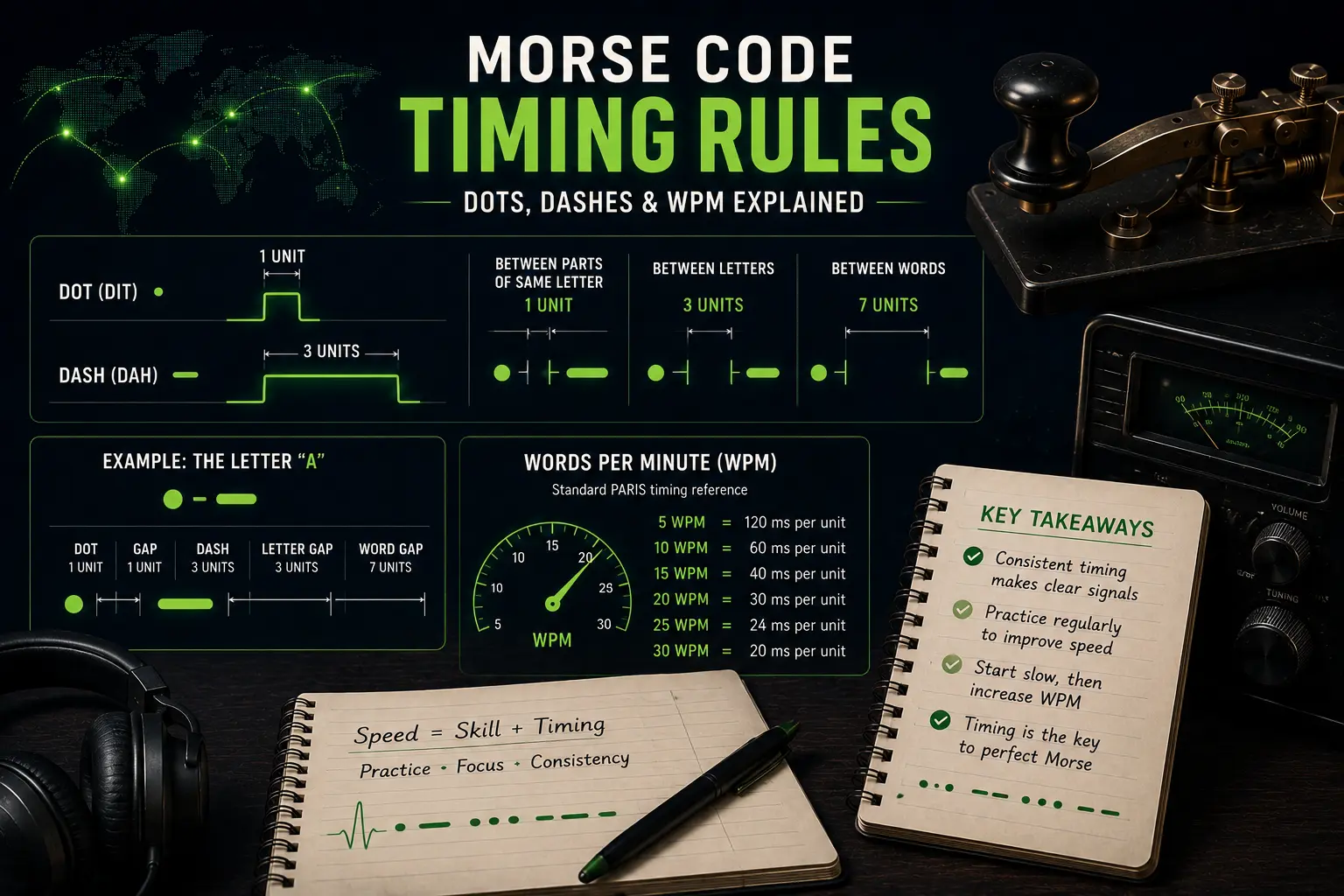
Understanding Morse code timing is essential for both transmitting and receiving the code accurately. If you want to practice the characters themselves alongside the timing rules, our Morse Code Alphabet provides the complete A-Z reference. Unlike a written alphabet where speed is flexible, Morse code has strict timing rules that govern the relationship between dots, dashes, and the gaps between them. This technical guide covers everything you need to know about Morse code timing, speed measurement, and practice techniques.
The Fundamental Timing Unit
All Morse code timing is based on a single fundamental unit: the length of one dot. Every other timing element is defined as a multiple of this unit:
- One dot (dit): 1 unit
- One dash (dah): 3 units (exactly three times the length of one dot)
- Space between parts of the same letter: 1 unit (equal to one dot)
- Space between letters: 3 units (equal to one dash)
- Space between words: 7 units (used for clear separation between words)
These ratios are absolute and must be maintained for the code to be correctly interpreted. If the timing ratios are wrong, the receiving operator will not be able to distinguish between, for example, the letter I (··) and the letter M (——) if the dash-to-dot ratio is not maintained.
Visualizing the Timing
Let us look at the letter “C” (—·—·) as an example:
- Dash: 3 units (———)
- Gap within letter: 1 unit
- Dot: 1 unit
- Gap within letter: 1 unit
- Dash: 3 units (———)
- Gap within letter: 1 unit
- Dot: 1 unit
Total for letter C: 3 + 1 + 1 + 1 + 3 + 1 + 1 = 11 units
This systematic approach to timing means that every letter has a predictable, measurable duration, which is what allows operators to develop the ability to recognize characters by their rhythm.
Words Per Minute (WPM): How Speed Is Measured
Morse code speed is measured in Words Per Minute (WPM), but this requires a standard definition of what constitutes a “word.” The universally accepted standard word is “PARIS”.
Why PARIS?
The word “PARIS” was chosen as the standard because it represents exactly 50 timing units:
- P (·——·): 2 dots + 1 dash = 2×1 + 1×3 + 3 intra-character gaps = 6 + 2 = 12 units (including element gaps: dit + 1-unit gap + dah-dah + 1-unit gap + dit = 1+1+3+1+3+1+1 = 11 units; more precisely, P has 4 elements and 3 intra-character gaps: 2 dots(2) + 1 dash(3) + 3 gaps(3) = 8, plus the 5 element lengths: actually let me recalculate)
Let me be more precise. The total units for “PARIS” including standard inter-element gaps:
- P: · (1) + gap (1) + ——— (3) + gap (1) + ——— (3) + gap (1) + · (1) = 11 units
- A: · (1) + gap (1) + ——— (3) = 5 units
- R: · (1) + gap (1) + ——— (3) + gap (1) + · (1) = 7 units
- I: · (1) + gap (1) + · (1) = 3 units
- S: · (1) + gap (1) + · (1) + gap (1) + · (1) = 5 units
Subtotal for characters: 11 + 5 + 7 + 3 + 5 = 31 units Inter-letter gaps (4 gaps between 5 letters): 4 × 3 = 12 units Inter-word gap (1 gap after the word): 1 × 7 = 7 units
Total: 31 + 12 + 7 = 50 units
This is why one WPM in Morse code equals exactly 50 timing units per minute. The relationship is:
- 1 WPM = 50 units per minute
- 5 WPM = 10 units per second (dot length = 1 second)
- 10 WPM = 20 units per second (dot length = 500 milliseconds)
- 15 WPM = 30 units per second (dot length = 333 milliseconds)
- 20 WPM = 40 units per second (dot length = 250 milliseconds)
- 25 WPM = 50 units per second (dot length = 200 milliseconds)
- 30 WPM = 60 units per second (dot length = 167 milliseconds)
Character Speed vs. Effective Speed
An important distinction in Morse code practice is between character speed and effective speed (also called overall speed).
- Character speed is the speed at which each individual character is sent. A character sent at 20 WPM character speed means each dot is 60 milliseconds long.
- Effective speed is the overall speed including the gaps between characters and words. If characters are sent at 20 WPM but with extra-long gaps, the effective speed might be only 12 WPM.
This distinction is the basis of the Farnsworth method (see below).
The Farnsworth Method
Developed by Donald Farnsworth in the 1950s, the Farnsworth method is one of the most important techniques in Morse code training. It addresses a critical problem: when beginners practice at slow speeds, the dots and dashes are drawn out so long that the rhythmic pattern of each character is lost. At 5 WPM, a dash is a full 600 milliseconds long — the rhythm that makes characters recognizable at 20 WPM is completely absent.
The Farnsworth solution is elegant:
- 1Send each character at a higher speed (typically 15-20 WPM character speed)
- 2Increase the gaps between characters and words to lower the effective speed
- 3Gradually reduce the extra gap time as proficiency improves
This way, the learner hears each character at its proper speed and rhythm, but has more processing time between characters. As the extra gaps are reduced, the effective speed approaches the character speed.
Most modern Morse code training software implements the Farnsworth method. A typical setup for beginners might be:
- Character speed: 15 WPM
- Effective speed: 10 WPM
- This means the gaps are stretched to slow the overall pace while maintaining proper character rhythm
Practice Speed Benchmarks
Here are typical speed benchmarks for Morse code proficiency:
Beginner (0-10 WPM Effective)
At this stage, you are learning character patterns and building basic recognition. Focus on accuracy over speed. The Koch method at 10 WPM effective speed with 15-20 WPM character speed is ideal.
Intermediate (10-15 WPM Effective)
You can copy most common characters reliably and are starting to recognize words without consciously decoding each letter. Practice with real-world text and increase your speed gradually.
Advanced (15-20 WPM Effective)
At 15-20 WPM, you are achieving the speed required for many amateur radio licenses and practical on-air communication. Characters are recognized instantly by sound, not by counting.
Expert (20-30+ WPM Effective)
Expert operators can comfortably copy code at 20-30 WPM and higher. At these speeds, entire words and common phrases are recognized as single sound patterns. This level of proficiency typically requires months or years of regular practice.
Elite (40-75+ WPM)
The world's fastest Morse code operators achieve speeds of 40-75+ WPM. At these speeds, the operator is essentially performing real-time auditory-to-text conversion with no conscious processing of individual characters.
Common Timing Mistakes
When learning Morse code, several timing errors are common:
Uneven Dot Lengths
All dots within a transmission should be the same length. Beginners often make some dots shorter than others, particularly when a letter contains multiple dots (like H: ···· or S: ···).
Dash-to-Dot Ratio Incorrect
The dash should be exactly three times the length of a dot. A common mistake is making dashes too short (closer to 2×) or too long (4× or more), which distorts the character rhythm.
Insufficient Inter-Character Gaps
Rushing the gap between letters (less than 3 dot lengths) is a common mistake when trying to increase speed. This causes letters to run together and become unrecognizable to the receiving operator.
Variable Word Spacing
The gap between words should be 7 units. Beginners sometimes make this gap too short (5 units, causing words to merge) or too long (9+ units, unnecessarily slowing the overall transmission speed).
Timing in Practice Sessions
When using Morse code training software or practicing with a partner, pay attention to these timing settings:
- Set the dot/dash ratio to exactly 1:3
- Set intra-character gaps to 1 unit
- Set inter-character gaps to 3 units (for standard practice; longer for Farnsworth)
- Set inter-word gaps to 7 units
- Monitor the character speed and effective speed separately
By understanding and respecting Morse code timing rules, you will develop clean, readable transmissions that other operators can copy easily. Timing discipline is one of the hallmarks of a skilled Morse code operator.
To start practicing the timing techniques described here, read our 7-Step Learning Guide.
Keep Learning
Related Articles
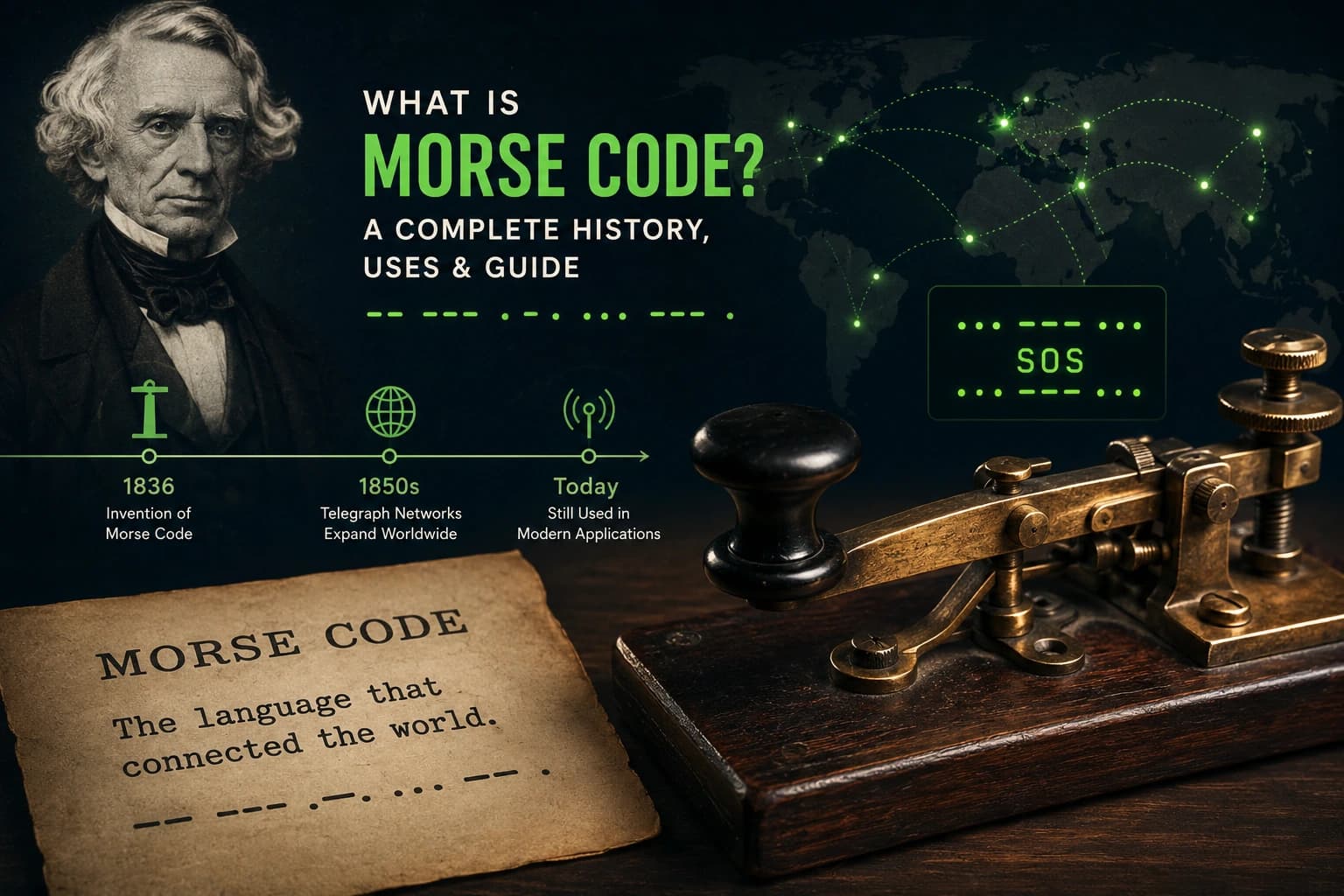
SOS Signal in Morse Code: Complete Emergency Guide
Complete guide to the SOS distress signal including its history, what SOS means, the Titanic story, how to signal SOS with light and sound, and modern emergency alternatives.
What is Morse Code? Complete History & Guide (2025)
Discover the fascinating history of Morse code from Samuel Morse's invention in 1836 to modern-day applications in emergency signaling, amateur radio, and assistive technology. A complete guide for 2025.
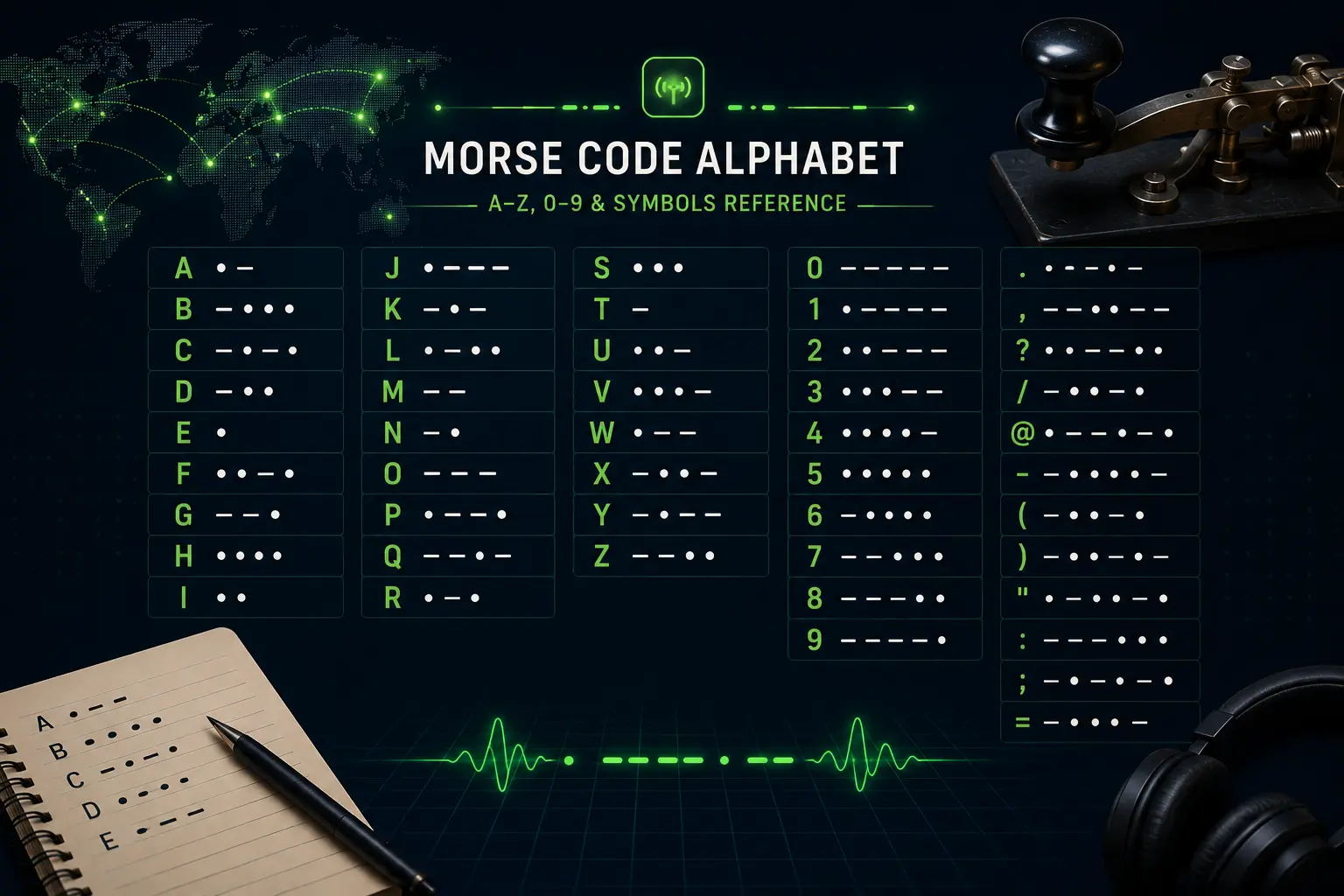
Morse Code Alphabet Chart: Complete A-Z, 0-9 & Symbols Reference
Full reference chart of all Morse code characters including letters A-Z, numbers 0-9, punctuation marks, and special characters with memorization tips and learning order recommendations.