25 Amazing Morse Code Facts You Didn't Know
Fascinating facts about Morse code from WWII POW communication and NASA to the fastest operators, cultural heritage, binary computing inspiration, and much more.
Written and reviewed by
Morse Code Translator TeamOur editorial team researches, writes, and reviews content to provide clear and accurate information about Morse code, communication standards, learning methods, and related topics.
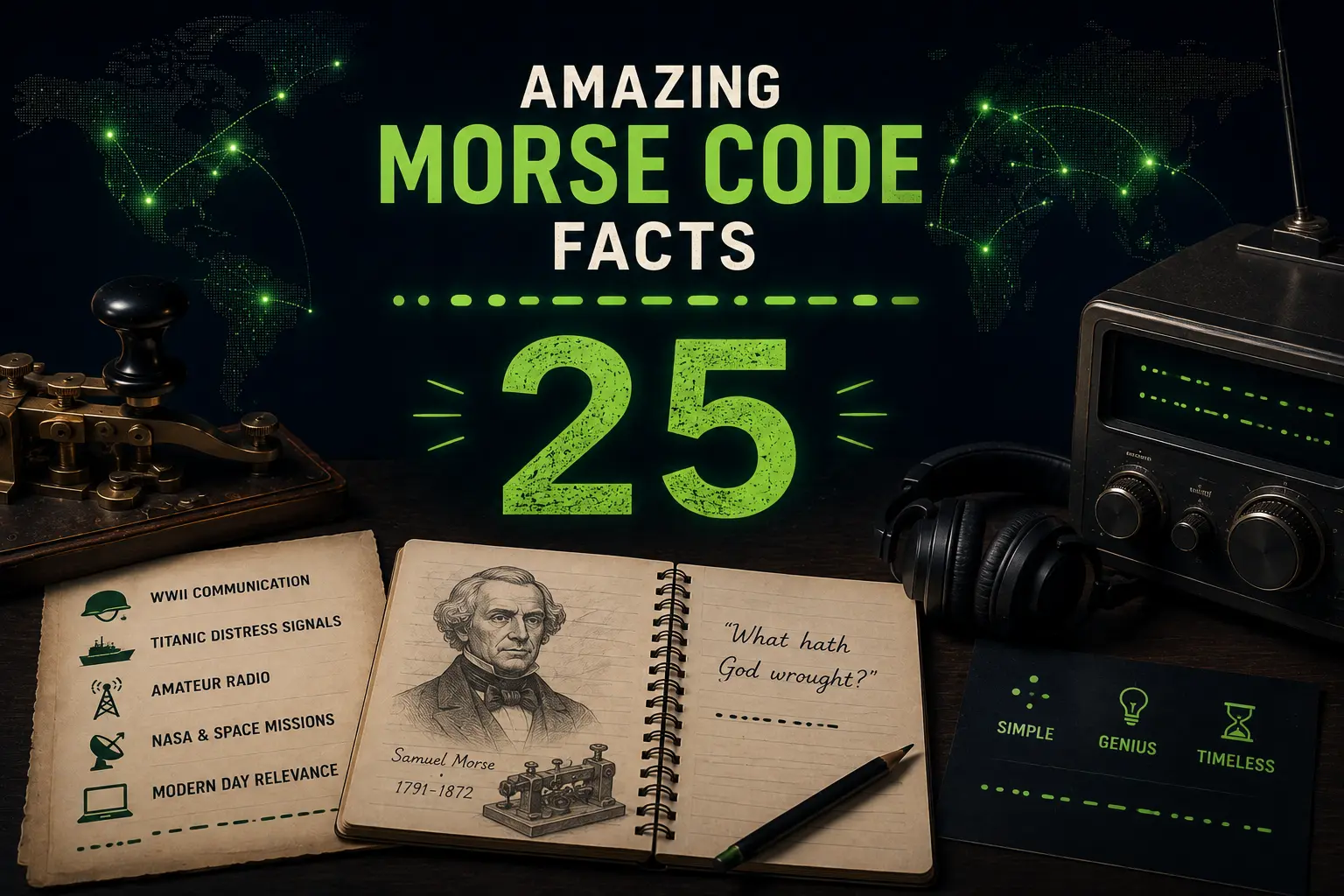
Morse code has a rich and surprising history that extends far beyond its role as a telegraph communication system. From saving lives in wartime to enabling communication for people with disabilities, Morse code has touched virtually every aspect of modern life. Here are 25 amazing facts about Morse code that will deepen your appreciation for this remarkable system.
Fact 1: The First Message Was a Biblical Quote
The first official Morse code message was sent on May 24, 1844, by Samuel Morse from the U.S. Capitol to Baltimore. The message — “What hath God wrought” — was chosen by Annie Ellsworth, the daughter of Morse's friend Henry Ellsworth. The phrase comes from Numbers 23:23 in the Bible and translates roughly to “What has God done?” — an appropriate exclamation for a revolutionary new technology.
Fact 2: The Fastest Morse Code Operators Reached 75+ WPM
The world's fastest Morse code operators achieved truly astonishing speeds. Theodore Roosevelt McElroy, operating as W1FJ, set a record by copying Morse code at over 75 words per minute during a competition. For context, this is faster than many people can write or type in plain English. These elite operators did not count dots and dashes — they recognized entire words by their rhythm, much like we recognize spoken words without analyzing individual phonemes.
Fact 3: SOS Is Not an Acronym
Despite the widespread belief that SOS stands for “Save Our Souls” or “Save Our Ship,” the signal was chosen purely for its simplicity and distinctiveness. For the full emergency explanation, see our SOS Morse Code Guide. The three-dot, three-dash, three-dot pattern is easy to send, easy to recognize, and impossible to confuse with any other Morse code sequence. The backronyms came later, created by sailors and the public to make the signal more memorable.
Fact 4: POWs Used Morse Code to Communicate Secretly
During World War II, prisoners of war developed ingenious methods for communicating using Morse code. One of the most famous techniques was the “tap code,” where prisoners tapped messages on cell walls or pipes between cells. Jeremiah Denton, a U.S. Navy pilot held as a POW in North Vietnam, famously blinked the word “TORTURE” in Morse code during a televised propaganda interview in 1966, alerting U.S. intelligence to the treatment of prisoners.
Fact 5: NASA Astronauts Used Morse Code as Backup
NASA has incorporated Morse code into multiple aspects of space exploration. Apollo astronauts carried Morse code capability as a backup communication method. In a famous example, astronaut John Young used Morse code to test a spacecraft's communication system. More recently, the Mars rovers have had Morse code encoded into their wheel treads — the pattern “JPL” (Jet Propulsion Laboratory) is left in the Martian soil as the rovers drive.
Fact 6: Morse Code Helps People with Severe Disabilities Communicate
One of the most inspiring modern applications of Morse code is assistive technology for people with severe physical disabilities. Using adaptive switches, sip-and-puff devices, or eye-tracking systems, individuals who cannot speak or use traditional keyboards can communicate using Morse code input. The simplicity of the two-signal system (dot and dash) makes it ideal for input devices that can detect even minimal movements.
Fact 7: The Titanic Used Both SOS and CQD
When the RMS Titanic struck an iceberg on April 14, 1912, the wireless operators initially sent the older CQD distress signal. At the suggestion of junior operator Harold Bride, they also began sending the newer SOS signal. The Titanic's distress calls were received by several ships, including the Carpathia, which rescued 706 survivors. The disaster cemented SOS as the universal distress signal.
Fact 8: Morse Code Inspired Binary Computing
The dot-dash binary nature of Morse code is a useful way to understand the broader idea of two-state encoding. For a deeper comparison between Morse code and computer data, see our Binary Code Translator Guide. The concept that complex information could be encoded using just two states (on/off, dot/dash, 0/1) is the fundamental principle underlying all modern computers. Samuel Morse and Alfred Vail, without knowing it, helped establish the conceptual foundation for the digital age.
Fact 9: NATO Still Trains Operators in Morse Code
Even in the era of satellite communication and encrypted digital systems, NATO military organizations continue to train personnel in Morse code. It is valued as a reliable backup communication method that requires minimal equipment and can operate on low-power, simple radio transmitters. In combat situations where advanced communication systems may be jammed or destroyed, Morse code remains a viable fallback.
Fact 10: A Telegraph Line Once Connected London to Calcutta
By the late 19th century, an overland telegraph line connected London to Calcutta, India — a distance of over 4,500 miles. This engineering marvel used Morse code to transmit messages in a fraction of the time it would take to physically carry them. Messages that previously took months by ship could now be delivered in hours.
Fact 11: There Is a Morse Code Version for Chinese Characters
While Morse code was designed for the Latin alphabet, a Chinese telegraph code was developed in 1871 by Danish merchant Emil Schjellerup. It assigns a four-digit number to each of approximately 6,000 common Chinese characters, and these numbers are then transmitted using standard Morse code. This system was widely used in China and remained in official use until the late 20th century.
Fact 12: The International Standard Was Adopted in 1865
International Morse Code was standardized at the International Telegraph Conference in Berlin in 1865, creating a uniform system that could be used across all nations. This standardization was crucial for international telegraph communication and is essentially the same system used today. The older American Morse Code, which had some irregular character patterns, gradually fell out of international use.
Fact 13: Lighthouses Use Morse Code for Identification
Lighthouses and navigation buoys often identify themselves using Morse code light patterns. A lighthouse might flash its light in a pattern that spells a specific letter, allowing mariners to identify which lighthouse they are seeing. This practice continues today and is part of international maritime navigation standards.
Fact 14: Morse Code Is Recognized Cultural Heritage
Morse code has been recognized by UNESCO and national heritage organizations as part of the intangible cultural heritage of humanity. Countries including France and Slovenia have formally listed Morse code in their national heritage registers, acknowledging its historical significance and cultural impact.
Fact 15: Your iPhone Can Flash SOS in Morse Code
Modern smartphones have built-in Morse code SOS functionality. On iPhones, rapidly pressing the power button (on iPhone 8 or later) activates Emergency SOS, which can flash the flashlight in the SOS pattern (three short, three long, three short) and simultaneously call emergency services and text your location to designated contacts. On Android, similar SOS features are available depending on the manufacturer.
Fact 16: The Letter E Is the Most Efficient Code
Morse code was brilliantly optimized for English language efficiency. The most common letter, E (representing about 12.7% of all English letters), is encoded as a single dot — the shortest possible signal. The second most common letter, T, is a single dash. This frequency-based optimization means that the average Morse code transmission is significantly shorter than it would be with a random assignment of codes to letters.
Fact 17: Amateur Radio Operators Still Use Morse Code Daily
The amateur radio community remains one of the most active users of Morse code. Known as “CW” (Continuous Wave) in ham radio terminology, Morse code communication is popular worldwide. CW allows long-distance communication with simple, low-power equipment — sometimes across continents with just a few watts of power. There are dedicated Morse code contests, nets (scheduled on-air meetings), and a vibrant community of CW enthusiasts.
Fact 18: Morse Code Works Through Touch
For people who are both deaf and blind, Morse code can be communicated through tactile means — by tapping patterns on a person's hand or arm, or using vibrating devices. This makes Morse code one of the few communication systems that works across all sensory modalities: visual (light), auditory (sound), and tactile (touch).
Fact 19: The Vietnam War's "Tap Code"
During the Vietnam War, American POWs developed a sophisticated tap code system based on Morse code principles. Unlike standard Morse code, which requires knowledge of letter patterns, the tap code used a simple grid system: the first set of taps indicated the row, and the second set indicated the column, mapping to letters of the alphabet. This system was taught to new prisoners and allowed extensive communication between cells despite constant surveillance.
Fact 20: Pilots Must Learn Morse Code for Navigation
Even in the era of GPS and digital avionics, pilots are required to learn Morse code to identify navigation beacons. VOR (VHF Omnidirectional Range) stations transmit a three-letter identifier in Morse code, and pilots must be able to decode this to confirm they are tuned to the correct frequency. This requirement remains part of pilot training worldwide.
Fact 21: The Last Commercial Morse Message Was Sent in 2006
Western Union, the company that dominated the telegraph industry for over a century, sent its last commercial Morse code message on January 27, 2006. The message marked the end of an era that had lasted more than 160 years. By this time, telegraphy had been almost entirely replaced by telephone, fax, and digital communication.
Fact 22: Morse Code Can Be Sent at the Speed of Light
Because Morse code is transmitted via electrical signals, radio waves, or light, its transmission speed is effectively the speed of light (approximately 186,000 miles per second or 300,000 kilometers per second). In practice, the limiting factor is the speed of the operator, not the transmission medium. A message sent from New York to London travels the transatlantic cable in a fraction of a second.
Fact 23: The Farnsworth Method Improves Learning Speed
The Farnsworth method, developed by Donald Farnsworth in the 1950s, dramatically improves Morse code learning. By sending individual characters at high speed while increasing the gaps between them, learners hear the proper rhythm of each character while having more time to process. For the exact timing ratios and WPM concepts behind this method, see our Morse Code Timing Guide.
Fact 24: There Are Over 20 International Morse Code Variations
While International Morse Code is the standard, many languages and scripts have developed their own Morse code variations. These include Morse code for Greek, Cyrillic, Arabic, Hebrew, Japanese (katakana), Korean, and other scripts. Each version adapts the dot-dash principle to the unique characters of its writing system, while maintaining the fundamental timing rules.
Fact 25: Morse Code Speed Is Measured Using the Word "PARIS"
Morse code speed is measured in words per minute (WPM), but the standard reference word is “PARIS.” This specific word was chosen because it represents exactly 50 timing units: P (·——· = 12), A (·— = 6), R (·—· = 8), I (·· = 4), S (··· = 6), plus standard spacing. One word per minute equals 50 timing units per minute, making “PARIS” the perfect benchmark for calibrating speed.
The historical milestones are covered in detail throughout this guide.
Keep Learning
Related Articles
SOS Signal in Morse Code: Complete Emergency Guide
Complete guide to the SOS distress signal including its history, what SOS means, the Titanic story, how to signal SOS with light and sound, and modern emergency alternatives.
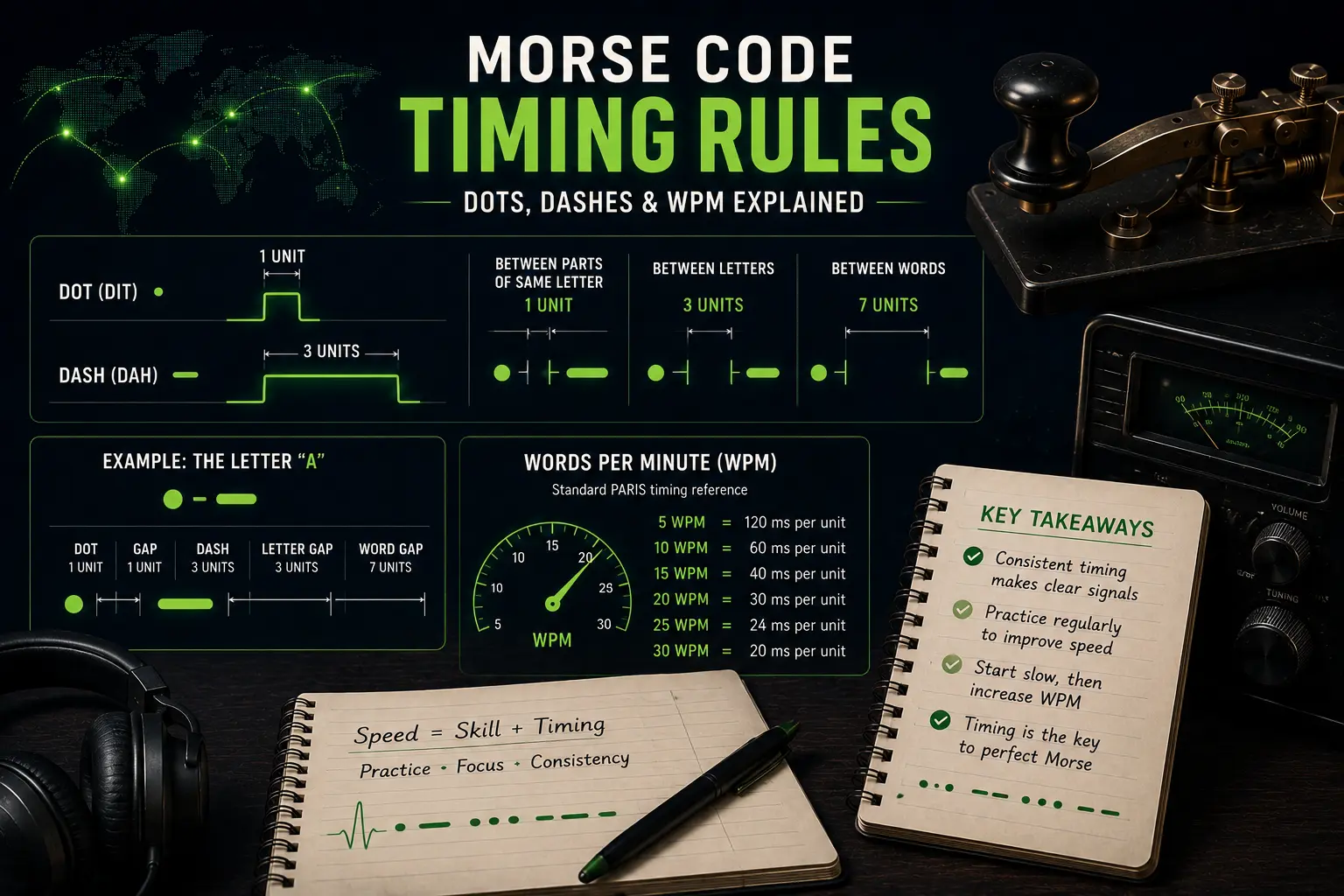
Morse Code Timing Rules: Dots, Dashes & WPM Explained
Complete guide to Morse code timing rules including the PARIS standard, dot/dash ratios, timing units, WPM calculation, Farnsworth method, and professional speed standards.
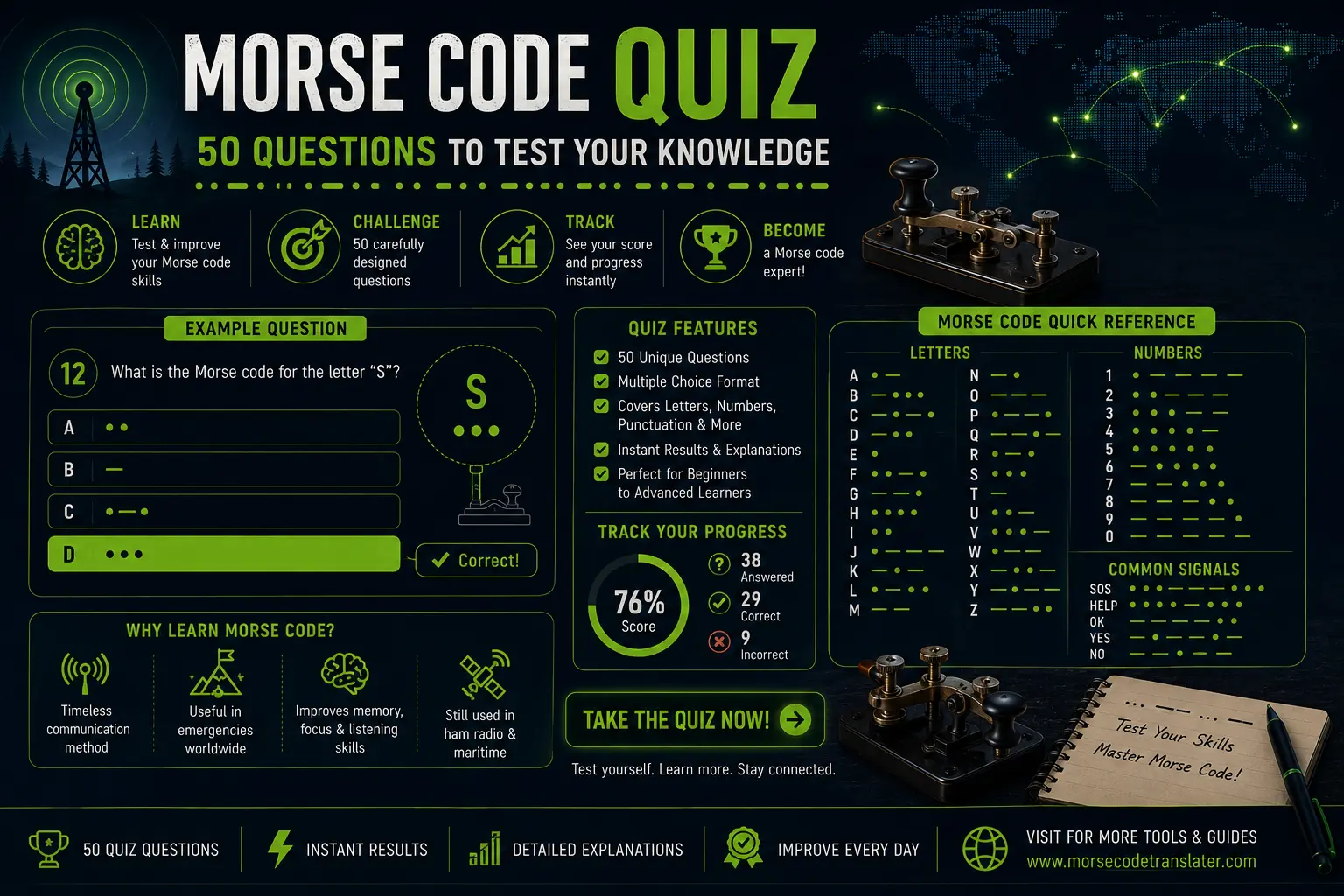
Morse Code Quiz: 50 Questions to Test Your Knowledge
50 quiz questions organized by difficulty from beginner to expert, covering letters, numbers, phrases, history, timing, and Morse code trivia with answers provided.