Morse Code in Modern Technology: Surprising Uses in 2025
Discover the surprising ways Morse code is used in modern technology from ham radio CW and accessibility tools to aviation NAVAIDs, maritime communication, iOS SOS, and military applications.
Written and reviewed by
Morse Code Translator TeamOur editorial team researches, writes, and reviews content to provide clear and accurate information about Morse code, communication standards, learning methods, and related topics.
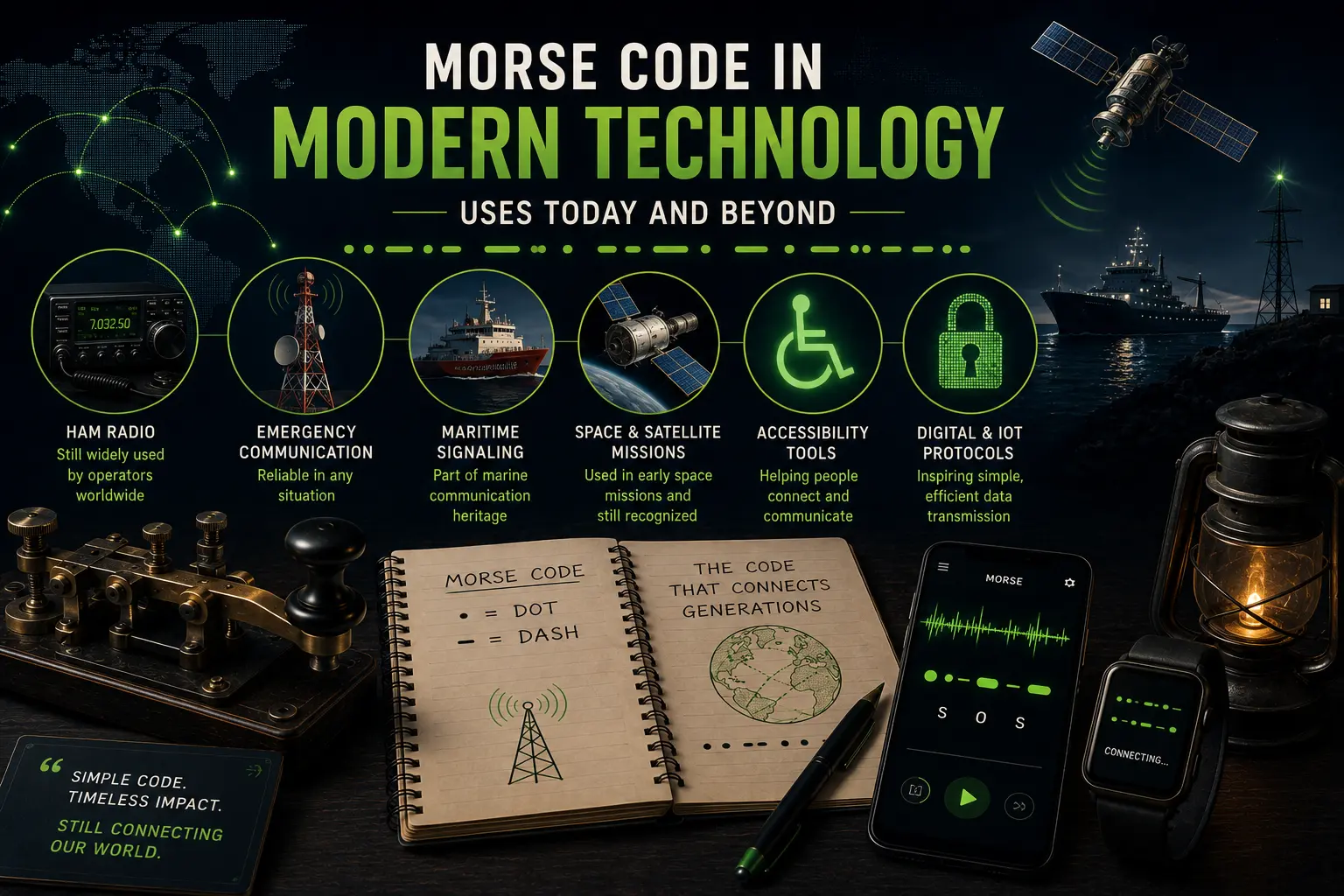
It would be easy to assume that Morse code is a relic of the past — a system rendered obsolete by the telephone, internet, and satellite communication. But nearly two centuries after its invention, Morse code continues to serve important roles in modern technology and daily life. For the historical background, see our Complete Morse Code History Guide. From emergency signaling on your smartphone to long-distance amateur radio communication, here are the surprising ways Morse code is used in 2025.
Amateur Radio (CW Communication)
Amateur radio is the single largest active community of Morse code users in the world. Ham radio operators use Morse code — referred to as “CW” (Continuous Wave) — for long-distance communication, and our Morse Code Timing Guide explains the timing and WPM concepts that matter when sending and receiving CW.
Why CW Remains Popular
- Efficiency: CW can get through when voice signals cannot. A well-tuned CW signal requires far less bandwidth than voice, making it more resilient to noise and interference. CW signals can often be copied when voice communication is completely unintelligible.
- Low power: CW allows effective communication with extremely low transmitter power. Operators routinely make contacts across oceans using just 5 watts or less — something virtually impossible with voice or digital modes at the same power level.
- Simplicity: CW equipment can be simple and inexpensive. While modern SDR (Software Defined Radio) transceivers offer sophisticated features, a basic CW transmitter and receiver can be built with a handful of electronic components.
- Community: The global CW community is passionate and supportive. Scheduled nets (regular on-air meetings), contests, and special event stations keep the tradition alive and thriving.
- No language barrier: While English is the de facto language of amateur radio, CW reduces language barriers because operators can use standard Q-signals (abbreviated prosigns like QTH for location, QSO for contact) that transcend language.
CW Contests and Activities
The amateur radio community organizes dozens of CW-focused contests each year, attracting thousands of operators worldwide. Events like the CQ World Wide CW Contest, the ARRL November Sweepstakes (CW), and the CQ WPX Contest are major international competitions where operators attempt to contact as many stations as possible over 24-48 hour periods.
Accessibility and Assistive Technology
One of the most impactful modern applications of Morse code is in assistive technology for people with severe physical disabilities. Morse code's simplicity — just two signals (dot and dash) — makes it ideal for input devices that can detect minimal movement.
How It Works
Specialized input devices allow individuals with conditions such as cerebral palsy, ALS, spinal cord injuries, or severe arthritis to communicate using Morse code input:
- Sip-and-puff devices: The user controls a switch by sipping (inhaling) and puffing (exhaling) through a tube. One action represents a dot, the other a dash.
- Single switch devices: Users with the ability to activate a single switch (through any voluntary movement — a finger twitch, head movement, or eye blink) can input Morse code by varying the duration of the switch press. A short press is a dot, a longer press is a dash.
- Eye-tracking systems: Modern eye-tracking technology can detect deliberate eye movements that translate into Morse code input.
- Brain-computer interfaces: Experimental systems can detect specific brain wave patterns and translate them into Morse code input, potentially allowing communication for individuals with locked-in syndrome.
Software Support
Google developed a Morse code keyboard plugin for Android (Gboard) in 2018, created in collaboration with Tania Finlayson, a Morse code expert who was born with cerebral palsy. The keyboard allows users to type entire messages using just two switches, with predictive text reducing the number of characters needed. The feature was also made available on iOS through third-party apps.
Aviation Navigation (NAVAIDs)
Even in the era of GPS and satellite navigation, Morse code plays an active role in aviation. VOR (VHF Omnidirectional Range) and NDB (Non-Directional Beacon) navigation stations transmit their identifying information in Morse code.
How Pilots Use Morse Code
Every VOR and NDB station has a three-letter identifier (such as “LAX” for Los Angeles International or “JFK” for John F. Kennedy). These identifiers are transmitted continuously in Morse code alongside the navigation signal. Pilots must be able to decode these Morse code transmissions to confirm they have tuned to the correct frequency — a critical safety check during instrument approaches and en-route navigation.
This requirement is why Morse code proficiency is still part of pilot training programs worldwide. While pilots do not need to be fast operators, they must be able to recognize and decode three-letter Morse code identifiers reliably.
Maritime Communication
While the international maritime community dropped the Morse code proficiency requirement for officers in 1999, Morse code remains present in maritime operations:
- Navigation buoys and lighthouses identify themselves using Morse code light patterns
- Some maritime radio equipment retains CW capability for emergency communication
- SOLAS requirements mandate that vessels carry equipment capable of transmitting distress signals
- Search and rescue operations may still receive Morse code signals from vessels in distress
The simplicity of Morse code means it can be transmitted using backup power systems when more sophisticated communication equipment has failed — a critical consideration in maritime emergencies.
Smartphone SOS Features
Modern smartphones have integrated Morse code into their emergency features:
iPhone SOS
On iPhone 8 and later, rapidly pressing the side button five times activates Emergency SOS. This feature:
- Automatically calls emergency services
- Sends your GPS location to designated emergency contacts
- Can optionally flash the flashlight in the SOS Morse code pattern (···———···)
- Sounds a loud alarm to attract attention
Android SOS
Most Android phones offer similar SOS features, though the specific activation method varies by manufacturer. Common options include:
- Pressing the power button five times rapidly
- Pressing and holding the power button
- Using a dedicated SOS button in the notification shade
The Morse code SOS flashlight feature is particularly valuable in situations where you are lost, injured, or unable to call for help verbally — it provides a visible distress signal that can be seen from considerable distances.
Military Applications
Despite the availability of advanced encrypted communication systems, military organizations worldwide continue to maintain Morse code proficiency as a backup communication method:
- NATO training programs include Morse code instruction as part of communications training
- Emergency backup communication: In scenarios where satellite communication is jammed, destroyed, or otherwise unavailable, Morse code can be transmitted on simple low-frequency radios that are hard to jam
- Prisoner of war training: Military personnel are trained in tap code communication (a Morse code variant) in case of capture
- Special operations: Small teams operating behind enemy lines may use low-power CW transmitters for stealthy communication that is difficult to detect and intercept
Pop Culture and Entertainment
Morse code has maintained a strong presence in popular culture:
- Movies and TV: Morse code appears in countless films and television shows, from war movies to spy thrillers. The trope of a prisoner tapping messages on a cell wall is a Hollywood staple.
- Music: Artists have incorporated Morse code rhythms into musical compositions, from classical pieces to electronic music. The dot-dash pattern provides a percussive element that translates naturally into rhythmic music.
- Video games: Morse code puzzles appear in numerous video games, challenging players to decode hidden messages.
- Social media: Morse code continues to trend on social platforms, particularly for encoding personal messages in bios, comments, and posts.
- Fashion and design: Morse code patterns are used in fashion, graphic design, and architecture as both decorative elements and hidden messages.
Education and STEM
Morse code is increasingly used as an educational tool in STEM (Science, Technology, Engineering, and Mathematics) programs:
- Binary thinking: Morse code introduces the concept of binary encoding (on/off, dot/dash) in an accessible, hands-on way
- Communication theory: Students learn about signal encoding, transmission efficiency, and noise tolerance
- History of technology: Morse code provides a tangible connection to the history of communication technology
- Electronics projects: Building simple telegraph circuits is a popular electronics project that teaches basic circuitry, electromagnetism, and signal processing
- Problem-solving: Decoding and encoding messages develops logical thinking and attention to detail
The enduring relevance of Morse code in 2025 demonstrates that good ideas do not become obsolete — they find new applications. A communication system based on just two signals, developed nearly 200 years ago, continues to serve humanity in ways its inventors could never have imagined.
To learn the basics, see our 7-Step Learning Guide.
Keep Learning
Related Articles

25 Amazing Morse Code Facts You Didn't Know
Fascinating facts about Morse code from WWII POW communication and NASA to the fastest operators, cultural heritage, binary computing inspiration, and much more.
I Love You in Morse Code: Complete Translation Guide
Full breakdown of I LOVE YOU in Morse code with each letter explained, creative uses including bracelets and tattoos, the morse code jewelry trend, and romantic gift ideas.
How to Learn Morse Code: 7 Proven Steps for Beginners
A step-by-step guide to learning Morse code from scratch using proven methods like the Koch method, Farnsworth timing, mnemonics, and daily practice routines.