When Was Morse Code Invented? Complete Timeline (1832-2025)
Detailed chronological timeline of Morse code from Samuel Morse's first concept in 1832 through the telegraph era, Titanic, WWII, and modern-day applications in 2025.
Written and reviewed by
Morse Code Translator TeamOur editorial team researches, writes, and reviews content to provide clear and accurate information about Morse code, communication standards, learning methods, and related topics.
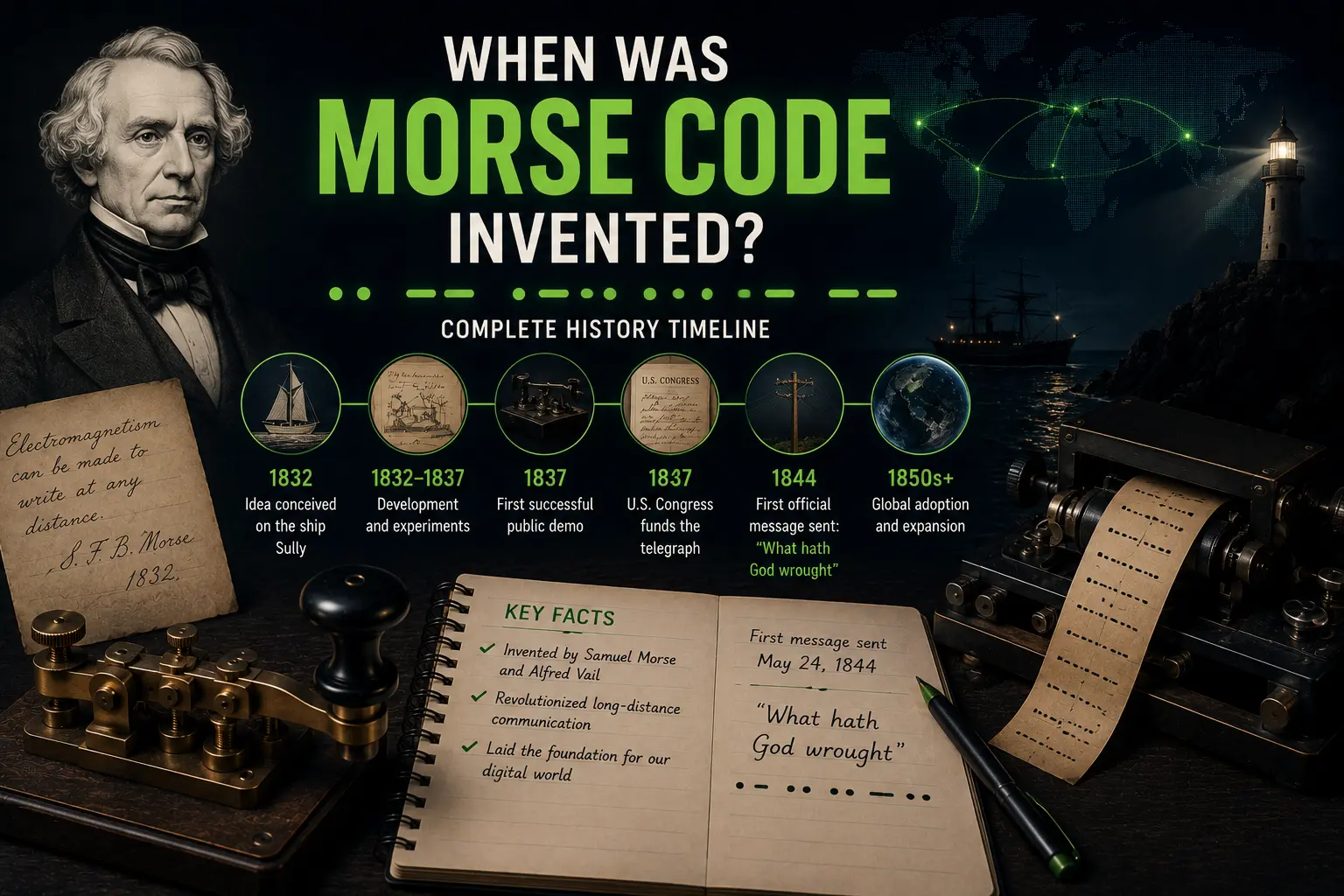
Morse code has a rich and eventful history spanning nearly two centuries. For the big-picture explanation before diving into individual dates, this timeline follows the major milestones in chronological order. From its conceptual origins aboard a transatlantic ship to its current role in amateur radio and emergency signaling, the story of Morse code mirrors the broader story of human communication technology. This complete timeline traces every major milestone from 1832 to 2025.
1832: The Spark of an Idea
The story of Morse code begins on the deck of the packet ship Sully in October 1832. Samuel F.B. Morse, a 41-year-old American portrait painter returning from a study trip to Europe, engaged in a dinner conversation with a fellow passenger about recent discoveries in electromagnetism. Morse learned from Charles Thomas Jackson, a Boston physician and science enthusiast, that electricity could travel instantaneously through a wire of any length.
This revelation struck Morse with enormous force. As a painter, he understood the power of communication, and the idea of transmitting messages through electrical signals captured his imagination. Before the voyage ended, Morse had sketched preliminary designs for an electromagnetic telegraph in his notebook, including a crude coding system using dots and dashes.
1835-1837: Development and Demonstration
Morse spent the next several years developing his telegraph concept while continuing to work as a painter and professor of art at New York University. During this period, he taught himself the necessary science, built experimental apparatus, and refined his coding system.
In 1835, Morse constructed his first working telegraph prototype. The device used an electromagnet to move a pencil that marked a moving strip of paper with dots and dashes as electrical pulses were applied to the wire. By September 1837, Morse had developed a reliable enough system to demonstrate publicly.
The critical partnership with Alfred Vail formed during this period. Vail, whose father owned the Speedwell Iron Works in Morristown, New Jersey, brought mechanical expertise and financial backing to the project. Vail's contributions to both the hardware design and the coding system were substantial — he developed the more efficient letter-based code that replaced Morse's original number-based dictionary system.
1838: Patent Filed
On January 15, 1838, Morse demonstrated his telegraph to a scientific audience at the Franklin Institute in Philadelphia. The demonstration successfully transmitted signals over approximately ten miles of wire coiled around the lecture hall.
Later that year, Morse applied for a patent on his electromagnetic telegraph, which was granted in 1840 (U.S. Patent 1,647). This patent protected the fundamental concept of the electromagnetic telegraph and would later be the foundation of a vast commercial enterprise.
1843: Congressional Funding
After years of lobbying Congress for support, Morse finally succeeded. On March 3, 1843, Congress appropriated $30,000 (approximately $1.1 million in today's dollars) for the construction of an experimental 40-mile telegraph line between Washington, D.C., and Baltimore, Maryland.
This appropriation was far from certain. Multiple previous attempts had failed, and many members of Congress were skeptical of the telegraph's practical value. The final vote in the House of Representatives was close — reportedly passing by a margin of just 89 to 83.
1844: The First Public Message — "What Hath God Wrought"
On May 24, 1844, Samuel Morse sent the first official public telegraph message from the Supreme Court chamber in the U.S. Capitol to Alfred Vail at the Mount Clare railroad depot in Baltimore. The message — “What hath God wrought” — was chosen by Annie Ellsworth, daughter of the Commissioner of Patents.
The message traveled the 40-mile distance in a matter of seconds. This moment is widely regarded as the birth of the telegraph age and one of the most significant milestones in communication history. A plaque now marks the location in the Capitol where Morse sat at his telegraph instrument.
1845-1850: The Telegraph Boom Begins
The success of the Washington-Baltimore line triggered rapid expansion. By 1846, telegraph lines were being strung along railroad rights-of-way across the northeastern United States. The Magnetic Telegraph Company, founded in 1845, was one of the first commercial telegraph enterprises.
In 1848, the Associated Press was formed to share news stories among member newspapers via telegraph — fundamentally changing how news was gathered and distributed. By 1850, approximately 12,000 miles of telegraph wire had been strung in the United States.
1851: Western Union Founded
The New York and Mississippi Valley Printing Telegraph Company was founded in 1851, later to become Western Union. Western Union would eventually build the most extensive telegraph network in the world and dominate the industry for over a century.
The first transcontinental telegraph line was completed on October 24, 1861, connecting the East Coast to the West Coast and rendering the Pony Express obsolete almost overnight.
1861-1865: The Civil War
The American Civil War was the first major conflict to make extensive use of telegraph communication. President Abraham Lincoln made regular use of the telegraph office in the War Department building, sending and receiving messages from his generals. The Union Army established a dedicated Military Telegraph Corps, which laid approximately 15,000 miles of wire during the conflict.
Lincoln's use of the telegraph is considered revolutionary in military history — it was the first time a head of state could communicate directly with field commanders in real time during an ongoing conflict.
1865: International Standardization
The International Telegraph Conference held in Paris in 1865 established the first international standards for telegraphy, including the adoption of a standardized version of Morse code. This International Morse Code replaced various national variations and created a uniform system that facilitated global telegraph communication.
The conference was a landmark event in international cooperation, with 20 nations participating in the negotiations. The standards established there formed the basis for the International Morse Code still used today.
1866: Transatlantic Cable
The first permanently successful transatlantic telegraph cable was completed on July 27, 1866, connecting Valentia Island, Ireland, to Heart's Content, Newfoundland. After several earlier failed attempts (including the 1858 cable that failed after only three weeks), this cable provided reliable transatlantic communication for the first time.
The impact was immediate and profound. A message that once took two weeks by ship could now cross the Atlantic in minutes. The cable was an engineering triumph that demonstrated the era's technological capabilities.
1901: Marconi's Transatlantic Wireless Signal
On December 12, 1901, Guglielmo Marconi received the first transatlantic wireless signal (the letter “S” in Morse code: ···) at Signal Hill, Newfoundland, from Poldhu, Cornwall, England. This achievement demonstrated that wireless telegraphy could span the Atlantic, and it laid the groundwork for modern radio communication.
1903-1906: SOS Adoption
In 1903, the first international regulations for wireless telegraphy at sea were established. The distress signal CQD was adopted by the Marconi company. However, in 1906, the International Radio Telegraphic Convention in Berlin adopted SOS (···———···) as the international distress signal due to its simplicity and distinctiveness. SOS became mandatory on July 1, 1908.
1912: The Titanic Disaster
The sinking of the RMS Titanic on April 14-15, 1912, was the defining event in Morse code emergency communication history. The ship's wireless operators, Jack Phillips and Harold Bride, sent both CQD and SOS distress signals. The disaster led to the first International Convention for the Safety of Life at Sea (SOLAS) in 1914, mandating 24-hour wireless watchkeeping on all ships.
1914-1918: World War I
Morse code played a crucial role in World War I military communication. Radiotelegraphy using Morse code was the primary means of long-distance military communication, and both Allied and Central Powers relied heavily on it for coordinating operations. The war drove rapid advances in radio technology and Morse code training.
1939-1945: World War II
During World War II, Morse code was indispensable. It was used for:
- Ship-to-ship and ship-to-shore communication across all theaters of war
- Aircraft communication, particularly for long-range bomber missions
- Espionage and resistance communication, with undercover agents using portable Morse code transmitters
- POW communication, using tap codes and smuggled radio equipment
- Naval convoy coordination across the Atlantic and Pacific
The war also accelerated the development of automated Morse code transmission and reception equipment.
1950s-1970s: Gradual Decline
After World War II, Morse code's role in commercial communication gradually diminished. Voice communication, teletype machines, and eventually digital computer networks began replacing Morse code for most purposes. The Cold War maintained some military demand, but commercial telegraph traffic steadily declined.
Amateur radio remained the primary domain of Morse code during this period, with operators maintaining the tradition of CW (Continuous Wave) communication.
1999: Maritime Morse Code Requirement Dropped
The International Maritime Organization dropped the requirement for ships to maintain Morse code operators as of February 1, 1999. The Global Maritime Distress and Safety System (GMDSS) had made Morse code proficiency unnecessary for maritime safety. This was a symbolic milestone in Morse code's transition from a commercial necessity to a specialized skill.
2003: Amateur Radio Morse Requirement Reduced
The International Telecommunication Union (ITU) revised international regulations to allow countries to eliminate Morse code proficiency requirements for amateur radio licenses. Many countries gradually removed the requirement, though some maintain a Morse code endorsement for certain license classes.
2006: Last Commercial Western Union Telegram
On January 27, 2006, Western Union sent its last commercial telegram, ending 160 years of telegraph service. The final message was a tribute to the telegraph's legacy. While Western Union still exists as a financial services company, its telegraph operation was permanently discontinued.
2010s-Present: Morse Code's Modern Renaissance
In recent years, Morse code has experienced something of a renaissance:
- Smartphone integration: iOS and Android have built-in SOS Morse code features
- Accessibility applications: Morse code is used in assistive technology for people with severe disabilities
- Cultural heritage: UNESCO recognition has raised awareness of Morse code's historical significance
- Ham radio popularity: Amateur radio continues to grow, with Morse code (CW) remaining the most popular mode for long-distance (DX) communication
- Creative expression: Morse code jewelry, tattoos, and art continue to gain popularity
- STEM education: Morse code is used in educational settings to teach binary thinking, communication theory, and history
2025: Morse Code in the Digital Age
Today, nearly two centuries after its invention, Morse code remains a living, active communication system. It is used daily by thousands of amateur radio operators, taught in military and aviation training programs, incorporated into emergency signaling systems, and celebrated as a cultural and historical treasure.
The story of Morse code is far from over. As long as there are people who appreciate elegant simplicity and reliable communication, dots and dashes will continue to carry meaning across the ether.
For a general overview, read our Complete History Guide. To explore fascinating details, see our 25 Amazing Facts.
Keep Learning
Related Articles
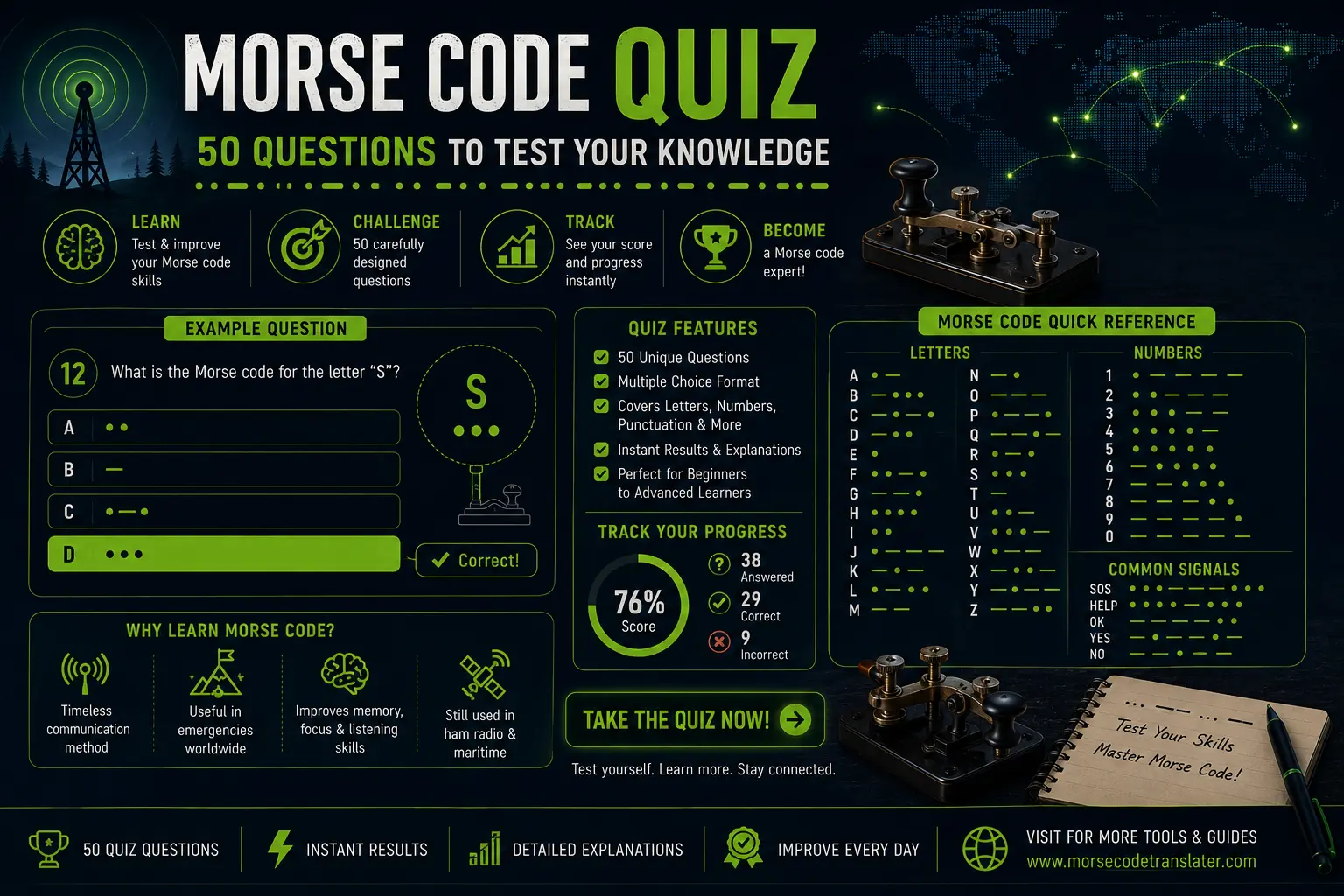
Morse Code Quiz: 50 Questions to Test Your Knowledge
50 quiz questions organized by difficulty from beginner to expert, covering letters, numbers, phrases, history, timing, and Morse code trivia with answers provided.
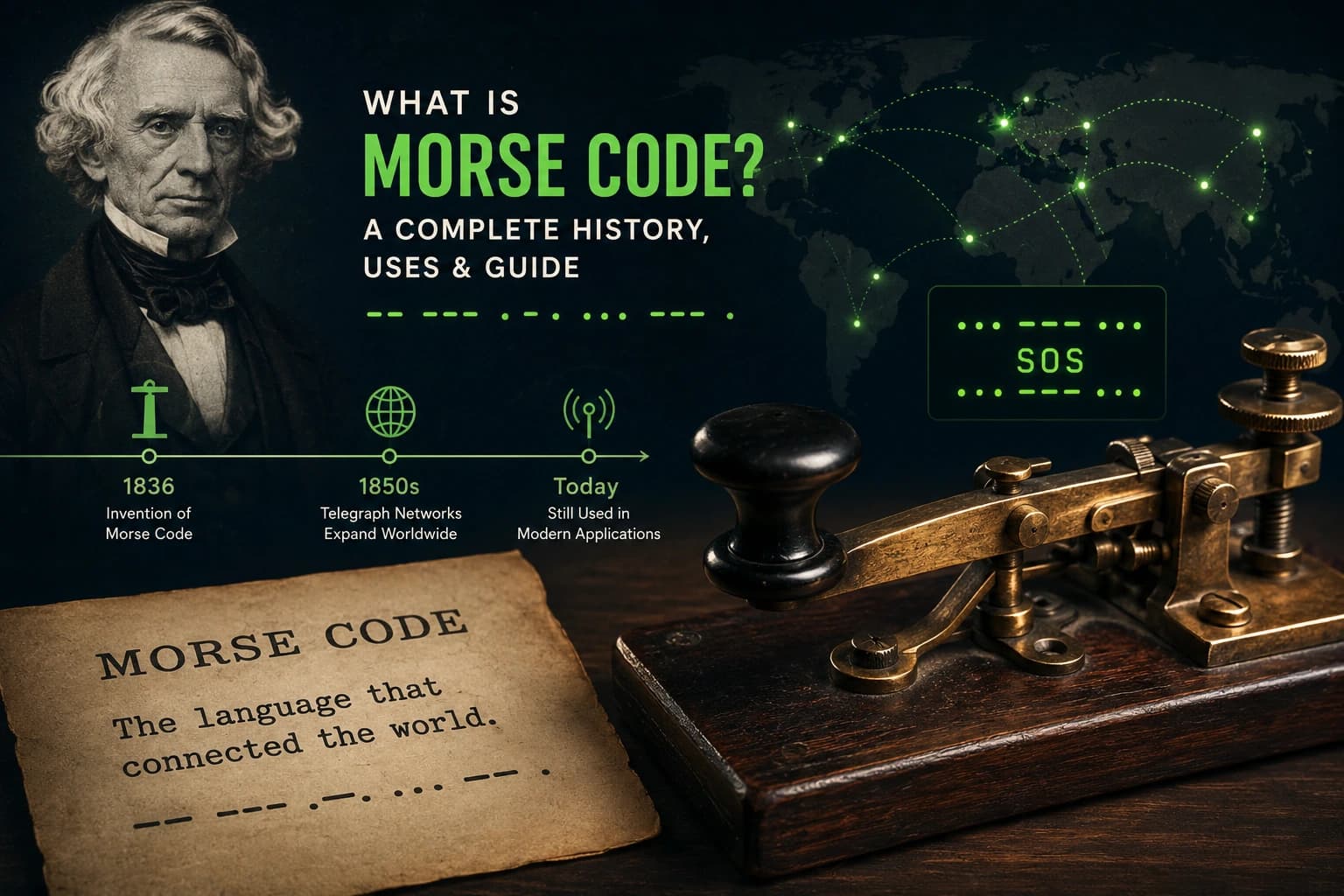
What is Morse Code? Complete History & Guide (2025)
Discover the fascinating history of Morse code from Samuel Morse's invention in 1836 to modern-day applications in emergency signaling, amateur radio, and assistive technology. A complete guide for 2025.
How to Learn Morse Code: 7 Proven Steps for Beginners
A step-by-step guide to learning Morse code from scratch using proven methods like the Koch method, Farnsworth timing, mnemonics, and daily practice routines.